A simple sensor brings real-time freshness testing to seafood, bypassing the need for complex sample preparation.
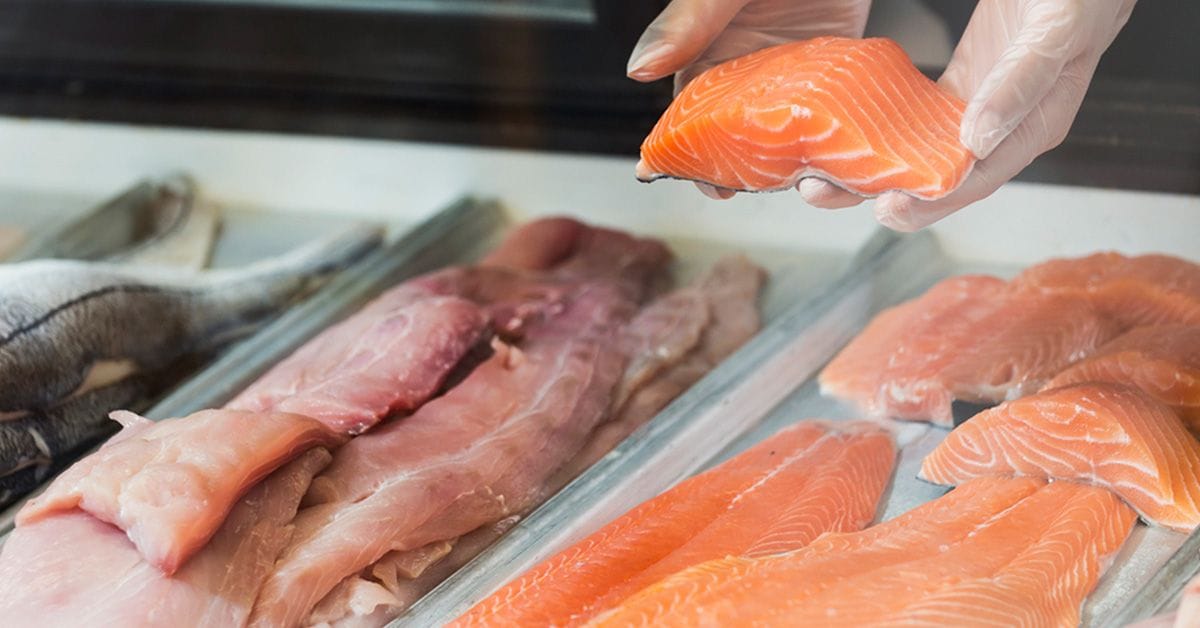
Assessing the freshness of seafood is essential for food safety and quality, but traditional checks, such as inspecting eyes and gills or relying on smell, often fall short. Spoilage can begin well before visible signs appear, making it difficult to catch early degradation. Electrochemical biosensors are becoming rapid, reliable, and affordable devices for real-time assessment of food quality, but their use can be limited by the need for sample preparation. Other approaches to freshness testing, such as optical devices and sensing films, have also been explored. These methods use fluorescence, spectroscopy, or bioimpedance to assess spoilage, but often face challenges with accuracy or practicality.
To address this, a team of researchers in Australia have developed a microneedle array-based electrochemical biosensor, designed for direct food safety and quality analysis without any sample preparation. Microneedles are ideal for biosensing, offering simple application and easy customization. The sensor can directly measure hypoxanthine (HX), a compound that forms early in the spoilage process and correlates with the breakdown of muscle tissue after death.
How the sensor works
Unlike standard laboratory techniques, which require extensive sample preparation and specialized equipment, this sensor works by simply pressing it onto the surface of the fish, eliminating the need for complex pretreatment. The device features a gold-coated polymeric microneedle array, functionalized with a chitosan-gold nanoparticle composite and immobilized xanthine oxidase. This configuration allows for selective detection of HX: the electrodes anchor into the fish tissue, where the enzyme breaks down HX and the sensor measures the resulting electrical changes.
Performance and validation
In tests, the researchers monitored salmon steaks stored at room temperature over 48 hours. The sensor was able to detect HX concentrations down to less than 500 parts per billion—levels consistent with “very fresh” fish—and delivered results in about 100 seconds. Its sensitivity and accuracy matched those of commercial laboratory kits, but with the added benefit of portability and speed.
Broader implications
This microneedle sensor represents a significant step toward real-time, on-site food safety monitoring. Its design overcomes the limitations of previous biosensors, which often required labor-intensive sample preparation and were confined to laboratory settings. By enabling direct analysis of whole fish tissue, the technology could help reduce food waste, improve quality grading, and reinforce consumer trust.
Explore related research in ACS journals:
Point-of-Care Meat Freshness Evaluation: Myoglobin-Involved Redox Reaction Analysis via Smartphone Imaging
Hui Zhu*, Yue Jiang, Yu-Ping Wei, Meng-Ying Ma, Jing-Tong Wang, Xing-Pei Liu, Ling Wang, and Chang-Jie Mao*
DOI: 10.1021/acs.analchem.5c02941
Freshness in Salmon by Hand-Held Devices: Methods in Feature Selection and Data Fusion for Spectroscopy
Mike Hardy*, Hossein Kashani Zadeh, Angelis Tzouchas, Fartash Vasefi, Nicholas MacKinnon, Gregory Bearman, Yaroslav Sokolov, Simon A. Haughey, and Christopher T. Elliott
DOI: 10.1021/acsfoodscitech.4c00331
A Covalently Anchored Biobased Nanofiber Label for Self-Reporting Fish Spoilage with High Stability and Radiometric Visibility
Qianjun Yin, Fushan Guo, Zhaoren Zhou, Tong Wan, Biao Wang, Bowen Xu, and Shaoyu Wang*
DOI: 10.1021/acs.iecr.5c04494
Construction of a Sensing Platform Integrated with a CRISPR/Cas12a-Triggered Colorimetric Strategy for the Quantitative Detection of Meat Freshness
Junsheng Sheng, Yang Dong, Siyu Sun, Yanbin Zhang, Changhe Li, Xinglian Xu, and Huhu Wang*
DOI: 10.1021/acs.jafc.5c04851
Flower-like FeWO4/f-MWCNTs Sphere for Triethylamine Gas Sensors Operating at Room Temperature: Sensing Performance, Mechanism Study, and Application to Detection of Fish Freshness
Zhihua Zhao*, Shuhan Chen, Huiqin Li, Lan Wu, Zhigang Shao, Qilin Zou, and Zhikun Wang*
DOI: 10.1021/acssensors.5c01416
Allosteric Aptamer CRISPR/Cas Activation Enables Non-competitive ATP Detection and Meat Freshness Assessment
Tai Ye, Mei Xue, Haohao Chen, Shuying Yue, Min Yuan, Jinsong Yu, Hui Cao, Liling Hao, Xiuxiu Wu, Fengqin Yin, and Fei Xu*
DOI: 10.1021/acs.jafc.5c12150
Stay Connected with ACS Sensors
Never miss an issue again! Sign up now for email updates on future calls for papers, the latest articles, and other content from ACS Sensors.