
Why do snakes excrete solid crystals instead of liquid waste? Discover how this adaptation helps reptiles survive and how it could unlock insights into human biology.
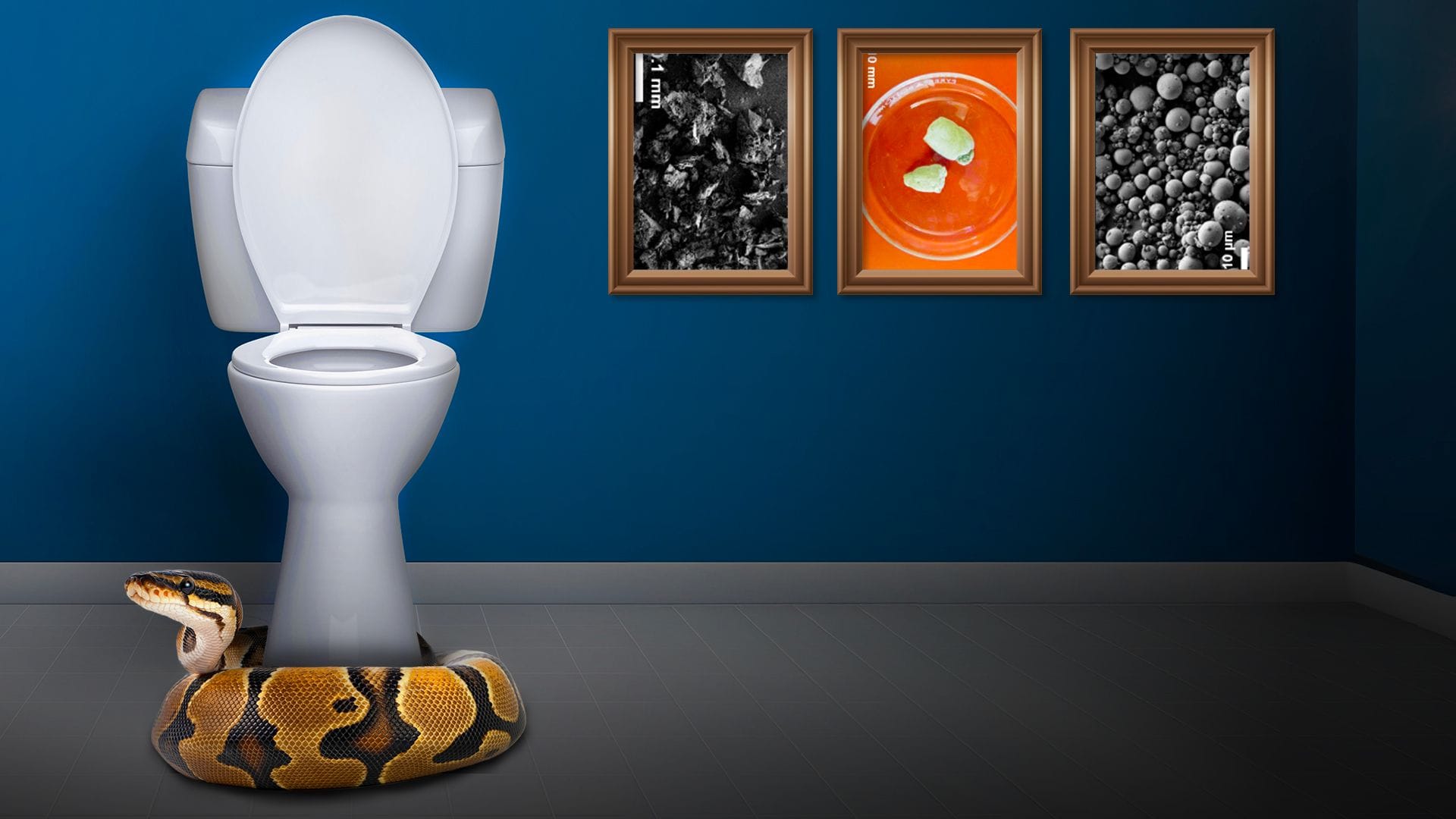
Across the animal kingdom, excess nitrogen from breaking down proteins is typically expelled as ammonia, urea, or uric acid. Aquatic animals can release pure ammonia, which is quickly diluted in water. Mammals, on the other hand, mostly excrete urea, and our urine also contains smaller amounts of ammonia and uric acid.
Reptiles and birds take a different route: they excrete solid clumps of uric acid called urates. This adaptation is especially useful in hot, dry environments, where saving water is critical.
Things get interesting when you consider humans and other primates. In our bodies, uric acid can crystallize, leading to gout and kidney stones. The contrast between reptiles’ efficient uric acid excretion and humans’ tendency toward crystal-related diseases raises some big questions: How do reptiles and birds manage large amounts of this stubborn compound? What exactly is the structure of this solid waste? And why might this matter for human health?
Recognizing function
A recent study published in Journal of the American Chemical Society sheds new light on these questions. By analyzing urate excretions from more than 20 reptile species, the team uncovered a surprisingly adaptable system for handling both nitrogenous waste and salts. The latest Headline Science video gets up close and personal with the research:

Key findings—and what it could mean for humans
Here's what the researchers discovered:
- Tiny spheres: Urates are made of microscopic balls packed with uric acid and water.
- Two patterns: Ancient snakes like pythons produce mostly uric acid microspheres. Modern snakes, like rattlesnakes, make granular waste rich in ammonium urate—but still have some spheres.
- A hidden role: Uric acid can react with ammonia to form a harmless solid, suggesting it evolved as a way to detoxify this neurotoxin.
Though more research is needed, this insight could one day inform new approaches to managing ammonia and uric acid in humans. “This research was really inspired by a desire to understand the ways reptiles are able to excrete this material safely, in the hopes it might inspire new approaches to disease prevention and treatment,” notes Jennifer Swift, the corresponding author on the study, in a recent ACS press release.
Watch more Headline Science on YouTube!
The video above is brought to you by the ACS Science Communications team. To watch more exciting videos and shorts covering some of the latest research in ACS journals, visit the Headline Science page on YouTube.
Video credits:
Written, produced, and hosted by Anne Hylden
Editing and animations by Vangie Koonce
Series produced by Vangie Koonce, Anne Hylden, Andrew Sobey, and Jefferson Beck
Executive produced by Matthew Radcliff
Explore related articles from ACS journals:
An Improved Model for Biogenic Ammonium Urate
Alyssa M. Thornton, Timothy G. Fawcett*, James A. Kaduk, YuJai Lin, and Jennifer A. Swift*
DOI: 10.1021/acs.cgd.3c00789
Kidney Stone Classification Using Multimodal Multiphoton Microscopy
Matthew Gleeson*, Joséphine Morizet, Pierre Mahou, Michel Daudon, Dominique Bazin, Chiara Stringari, Marie-Claire Schanne-Klein*, and Emmanuel Beaurepaire*
DOI: 10.1021/acsphotonics.3c00651
Uric Acid Crystallization Interrupted with Competing Binding Agents
Victoria M. Hall, Alyssa Thornton, Elizabeth K. Miehls, Jeffery A. Bertke, and Jennifer A. Swift*
DOI: 10.1021/acs.cgd.9b01225
Allopurinol Reprograms Uric Acid Self-Assembly by Disrupting Cytotoxic Fibrils and Redirecting Crystal Growth
Dana Laor Bar-Yosef, Damilola S. Oluwatoba, Hanaa Adsi, Happy Abena Safoah, Om Shanker Tiwari, Ilana Sogolovsky-Bard, Dor Zaguri, Davide Levy, Ehud Gazit, and Thanh D. Do*
DOI: 10.1021/jacsau.5c00812
Mechanical Properties of Anhydrous and Hydrated Uric Acid Crystals
Fan Liu, Daniel E. Hooks, Nan Li, Nathan A. Mara, and Jennifer A. Swift*
DOI: 10.1021/acs.chemmater.8b00939
Crystallization of Hierarchical Ammonium Urate: Insight into the Formation of Cetacean Renal Stones
Xi Geng, Jenny Meegan, Cynthia Smith, Khashayar Sakhaee*, and Jeffrey D. Rimer*
DOI: 10.1021/acs.cgd.9b01077
