
Researchers have engineered oil-in-water emulsions that grow directional “tentacles,” offering new possibilities for life-like materials that respond to the world around them.
Cells are tiny chemical powerhouses that form the basis of all living organisms. Inside each cell, countless reactions occur simultaneously, fulfilling the five key parameters of life: organization, metabolism, reproduction, heredity, and response to stimuli. That last parameter—response to stimuli—is of particular interest for researchers developing materials that can adapt to their environment.
When exposed to chemical cues, living cells form arm-like extensions called pseudopodia or finger-like protrusions called filopodia. This flexing of the cell membrane is the first step in cell migration and environmental sensing, properties that could one day be extremely useful in artificial systems.
Droplets That Mimic Cellular Sensing
Let’s take a step back for a moment—a giant step back, over 3 billion years. One hypothesis for the origin of life suggests that prebiotic Earth was rich in organic macromolecules. In this environment, self-assembled and compartmentalized microstructures could have emerged, allowing chemical systems to develop basic autonomy. These structures—vesicles, foam-like inorganic minerals, emulsions, and droplets—are primitive cellular models that may have played a key role in the origin of life.
Previous research has shown that surfactant partitioning is critical for the dynamic behavior of droplets. However, not all systems that show surfactant partitioning form filopodia, so this alone isn’t enough.
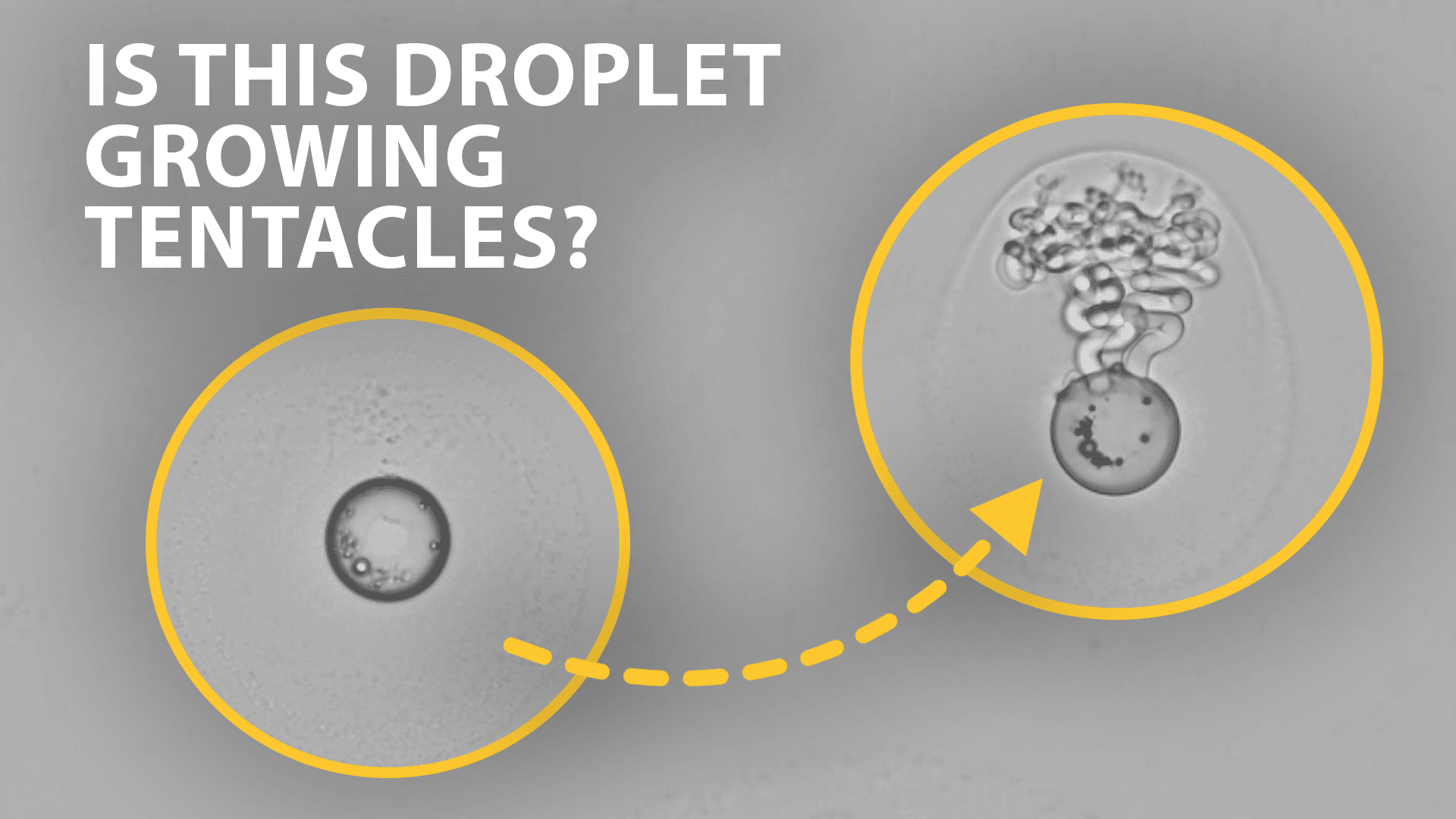
But in new work published in the Journal of the American Chemical Society, researchers at Penn State University have engineered oil-in-water emulsions that mimic how living cells sense and respond to their environment. Check out the Headline Science video below to see the team's work in action:
Droplets on the move: toward lifelike materials
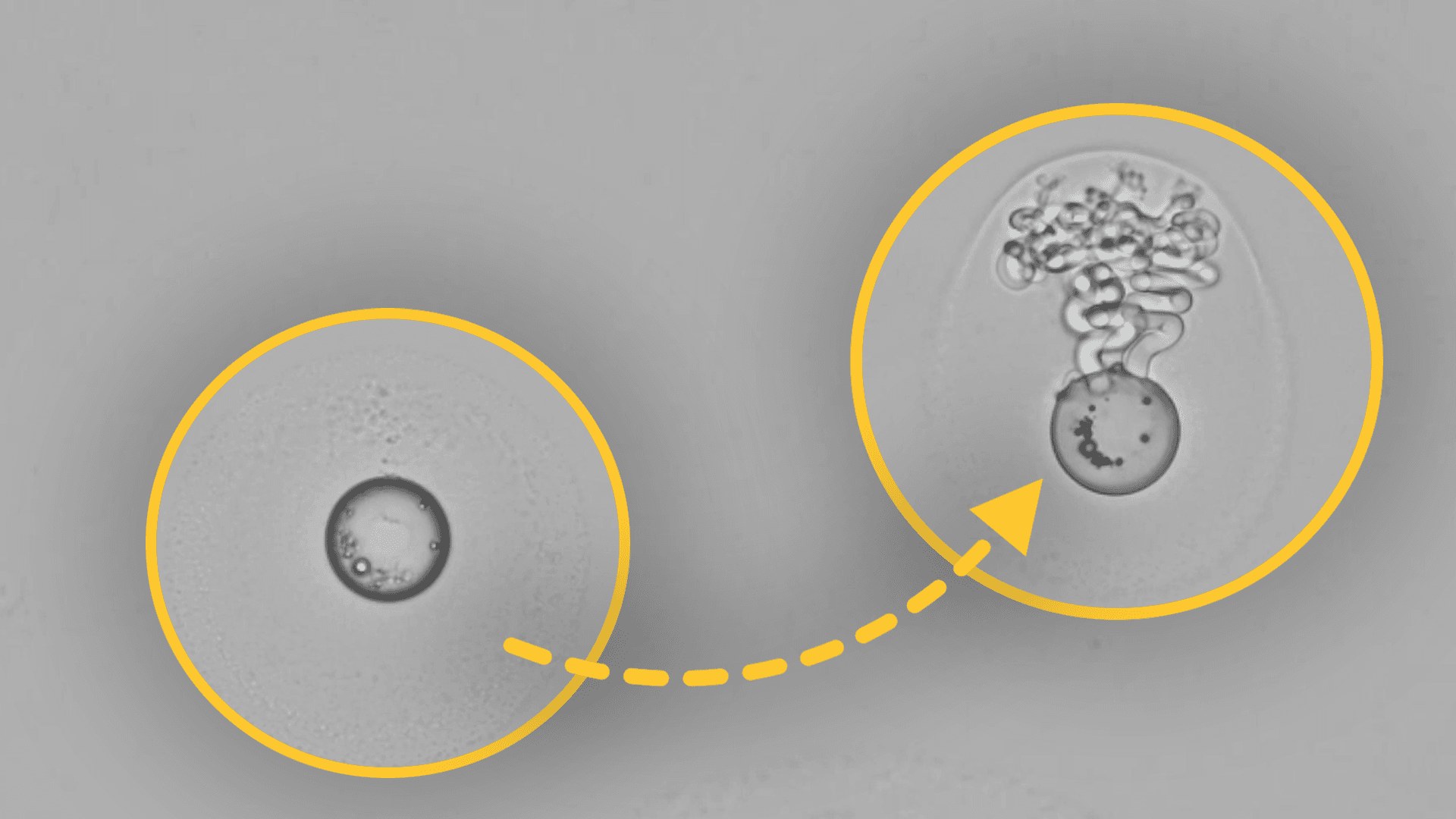
By adding a drop of bromobenzene oil to a surfactant solution, the team observed droplets forming dramatic finger-like protrusions (some resembling tentacles) thanks to unstable layers at the droplet’s surface that trap water in between.
What sets this research apart is the ability to control the direction in which these filopodia-like structures grow. The droplets respond to specific chemical gradients, growing toward some molecules and amino acids and away from others—just like living cells.
Unlike typical emulsions, where droplets simply shrink over time, filopodia formation is the initial step here, followed by rapid fragmentation and solubilization—a process reminiscent of apoptotic cell behavior. The underlying mechanism involves asymmetric surfactant partitioning across the oil–water interface, leading to the formation of lamellar structures that project out as filopodia.
The authors are optimistic that their exciting new findings could open new avenues for developing life-like materials that can both sense and grow in response to external stimuli.
Watch more Headline Science on YouTube!
The video above is brought to you by the ACS Science Communications team. To watch more exciting videos and shorts covering some of the latest research in ACS journals, visit the Headline Science page on YouTube.
Video credits:
Written and produced by Emily Schneider
Editing and animations by Vangie Koonce
Narrated by Vangie Koonce
Series produced by Vangie Koonce, Anne Hylden, Andrew Sobey, and Jefferson Beck
Executive produced by Matthew Radcliff
Explore related content from ACS Publications:
Blog Posts
Chemical Gardens in Motion: How Chemistry Imitates Life Across the Universe
Chemistry Imitating Life: Using Chemical Energy to Drive Primitive Cell Division
Journal Articles
Dynamic Partitioning of Surfactants into Nonequilibrium Emulsion Droplets
Rebecca V. Balaj, Wangyang Xue, Parvin Bayati, Stewart Mallory, and Lauren D. Zarzar*
DOI: 10.1021/jacs.4c08917
Chemically Fueled, Active Droplets Prevent the Aging of Peptides into Amyloid-Like Fibers
Monika Wenisch, Michele Stasi, Simone M. Poprawa, Brigitte A. K. Kriebisch, and Job Boekhoven*
DOI: 10.1021/jacs.5c12831
Self-Organization of Microcompartments Powered by Enzyme-Driven Solutal Flows at the Water–Oil Interface
Pankaj S. Patwal and B. V. V. S. Pavan Kumar*
DOI: 10.1021/jacs.5c11877
Chemical Programming of Solubilizing, Nonequilibrium Active Droplets
Kueyoung E. Kim, Rebecca V. Balaj, and Lauren D. Zarzar*
DOI: 10.1021/acs.accounts.4c00299
Systems of Creation: The Emergence of Life from Nonliving Matter
Stephen Mann
DOI: 10.1021/ar200281t
Artificial Cells: Synthetic Compartments with Life-like Functionality and Adaptivity
Bastiaan C. Buddingh’ and Jan C. M. van Hest*
DOI: 10.1021/acs.accounts.6b00512
