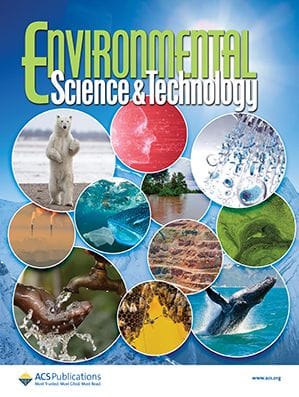
In this interview Dr. Zimmerman reflects on 60 years of Environmental Science & Technology, sharing how the journal has evolved to meet new challenges and shape new fields of research.

Environmental Science and Technology (ES&T) is celebrating 60 years in publication. We asked Editor-in-Chief Julie B. Zimmerman (Yale University) to reflect on this milestone anniversary, share her editorial vision, and imagine what the future might hold for the journal.
Reflections on 60 years
What has been the biggest change that you've seen for the journal during your career?
I have had the privilege of experiencing ES&T as an author, a reviewer, an Associate Editor, and now the Editor-in-Chief. In fact, the very first paper I ever published was in ES&T. The biggest change I have seen in the journal over these 20+ years is the increasing breadth, both of the scope and of the community.
What are some research trends that have emerged over the course of the journal's history that have stood the test of time?
ES&T has stood the test of time, not because of the specific topics that are covered in the pages, but because it is always evolving with the creativity of the community and the needs of society. The scope of the journal has continued to evolve along with challenges facing our environment. That is, ES&T has not merely chronicled environmental scientific insights and technological discovery, it has enabled and empowered the improvement of the environment upon which we all depend even as the problems we are facing become more complex, more global, and more chronic.
Can you reflect on any recent research that would have been unimaginable back in 1967? How has the field advanced to make this possible?
Much of what was unknowable in 1967 is now knowable when it comes to environmental research. The advances in analytical chemistry, sensor technology, integrated networks, artificial intelligence, and machine learning have made us acutely aware of the fate, transport, and adverse impacts of molecules on human health and the environment. This same information is incredibly powerful in informing the design of a safer material basis of our economy and our society.
Your Editorial Vision
How does the research published in ES&T help drive global change?
ES&T helps to drive global change because of its strong reputation for rigorous, relevant, and timely research. This has led to ES&T research serving as the basis of environmental policy regionally and globally to inform strategies for pollution prevention; control for air, water, and soil contamination; as well as guidance on how to address emerging pollutants. All of this leads to improved protection of human health and the environment, improved quality of life and well-being, and a more resilient, healthier, and sustainable future.
What role does the journal play in advancing interdisciplinary and emerging research areas?
Environmental challenges don’t recognize disciplinary boundaries, and one of ES&T’s most important roles is to bring those perspectives together. The journal has always been a place where chemistry, engineering, biology, and increasingly data science and public health intersect. Many of the areas that define our field today—emerging contaminants, environmental nanotechnology, planetary health—were once just emerging questions. By publishing rigorous work in these spaces early, ES&T helps give shape to new fields and helps the broader community see both the risks and the opportunities ahead.
What does being the Editor-in-Chief of ES&T mean to you?
It’s honestly both humbling and deeply meaningful. ES&T has such a remarkable legacy, and I feel a real responsibility to honor that while helping it evolve. What matters most to me is making sure the journal continues to publish science that truly makes a difference—that improves lives, informs decisions, and protects the environment. And it’s also about supporting the community behind that science.
On the Horizon
What do you think ES&T will look like 60 years from now?
I hope the defining characteristic of ES&T 60 years from now is the same as it is today—science in service to humanity. The tools will evolve dramatically. We’ll see far more integration of AI, real-time sensing, and predictive environmental science. But what I think will matter most is that the journal continues to publish work that helps society anticipate and prevent environmental harm, rather than simply reacting to it. And I expect it will reflect an even more global, diverse, and connected scientific community.
How can researchers best focus their collective efforts to solve some of the biggest environmental crises of our time?
I think it starts with remembering why we do this work in the first place. I think it begins with recognizing that environmental problems are systems problems. Solving them requires collaboration across disciplines and sectors, and it requires thinking beyond simply identifying problems to being intentional about designing solutions. It also requires keeping the ultimate purpose in mind. Our goal is not just to generate knowledge, but to improve the human condition and protect the planet.
What advice would you give to early-career researchers looking to contribute to the journal?
Focus on work that matters. The papers that stand out in ES&T are the ones that don’t just add information, but change understanding. And don’t be afraid to be bold. Some of the most important work challenges conventional thinking. Also, engage with the journal as part of a community—review, collaborate, and contribute your voice.
What emerging areas of inquiry are you most excited about?
I’m really excited by the shift toward designing chemicals and technologies to be safer and more sustainable from the very beginning. That’s a fundamental change. I’m also excited by how advances in data science and sensing are helping us see environmental systems in ways we never could before. But what gives me the most hope is the people—the next generation of scientists who are bringing new ideas and new urgency to this work.
Browse ES&T 60th Anniversary Collections

Featured Collection
The Global Impact of 60 years of ES&T
Throughout 2026 ES&T will commemorate its 60th diamond anniversary by launching a year-long series of monthly themed collections. The collections will focus on some of the impactful research topics or ‘facets’ of the ES&T diamond that have shaped six decades of the journal, from ecotoxicology to drinking water, chemical persistence to sustainable design, biogeochemical cycles to remediation, air quality to climate solutions.