Sunlight drives much of the chemistry in the air above the ocean. A new study suggests that tiny electrical discharges between sea-spray droplets, nicknamed microlightning, keep some of it going at night.
The marine boundary layer is where the lowest part of the atmosphere meets the ocean. At this interface, there are huge exchanges of moisture, heat, and momentum, and reactive gases form water-soluble compounds and aerosols that play a role in cloud formation and climate regulation. Much of this chemistry is driven by sunlight, which produces the oxidants that break down and transform other molecules in the air. But what happens after the sun goes down?
In a study published in Environmental Science & Technology, researchers report that freshly made sea spray keeps producing oxidants in the dark. Tiny electrical discharges between oppositely charged droplets, a phenomenon nicknamed “microlightning,” appear to be part of the reason.
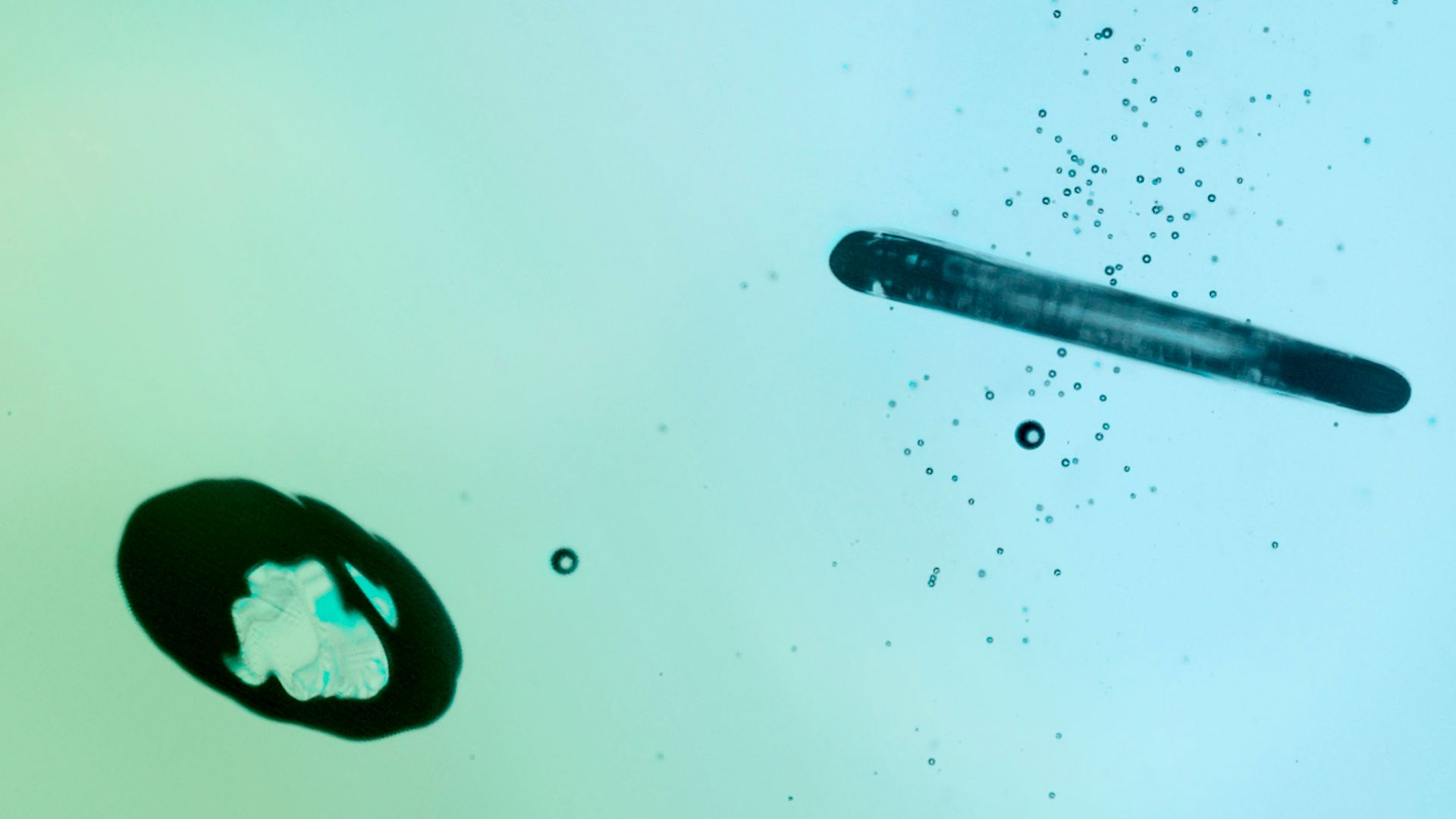
In this Headline Science short, see microlightning in action and find out why water chemistry “gets weird” at the edges.
Salt Should Have Shut This Down
Earlier studies reported reactive oxygen species in marine microdroplets even without light, but what drives that chemistry has been unclear. Reactions in water microdroplets are often credited to strong electric fields at the droplet surface, where charges separate and water molecules line up in particular ways. In seawater, though, high salt content compresses the electrical double layer at that surface, which should weaken the field. So what’s going on?
Into the Dark
The team collected sea spray around 10 p.m. at three coastal sites in eastern China and compared it with the seawater it came from. At every site, the spray had stronger oxidant signals than the source seawater. This suggests the oxidants form as the spray is made rather than simply being carried over from the ocean.
In the lab, salt strongly suppressed oxidation in single, isolated droplets. But when droplets were allowed to interact, they kept forming hydrogen peroxide and hydroxyl radicals, even in seawater. Isotope labeling traced the radicals to water rather than to trace impurities.
Real sea spray is rarely a collection of isolated droplets. It’s a crowded, constantly changing mist in which droplets approach one another, merge, and break apart. The team’s simulations showed that the electric field in the narrow gap between two charged droplets climbs sharply as they move closer together. The researchers also detected faint light emission during these interactions, consistent with tiny electrical discharges in the strong fields between droplets.
Clues from the Coast
In a spray chamber, ozone rose and nitrogen oxides (NOx) fell during active droplet generation. Nighttime records (8 p.m. to 5 a.m.) from the three coastal stations showed a similar pattern: periods with higher waves, which generally mean more sea spray, also had more ozone and less NOx and sulfur dioxide.
The authors caution that other factors also influence nighttime ozone, including wind, shifting air masses, and changes in boundary-layer height. That means the field data are consistent with their mechanism rather than proof of it. Still, the results point to interactions between oppositely charged droplets as an overlooked contributor to oxidation in nighttime sea spray, one that may help drive chemistry in the air above the ocean after sunset.
Watch More Headline Science on YouTube!
The video above is brought to you by the ACS Science Communications team. To watch more exciting videos and shorts covering some of the latest research in ACS journals, visit the Headline Science page on YouTube.
Video credits:
Written and produced by Anne Hylden
Edited and animated by Janali Thompson
Narrated and hosted by Anne Hylden
Series produced by Vangie Koonce, Anne Hylden, Andrew Sobey, Janali Thompson, Darren Weaver, Elaine Seward, and Jefferson Beck
Executive produced by Matthew Radcliff
Research videos from Yu Xia, Ph.D.
Explore Related Articles from ACS Journals
Ion-Specific Interfacial Electric Fields on Water Microdroplets for Tuning Menshutkin Reactions
Jianze Zhang; Ziyuan Liu; Chenghui Zhu; Shixuan Wang; Shuang Zhu; Chongqin Zhu*; Xinxing Zhang*
DOI: 10.1021/jacs.5c11766
Spontaneous Oxidation of Thiols and Thioether at the Air–Water Interface of a Sea Spray Microdroplet
Zepeng Rao; Xiaojiao Li; Ye-Guang Fang; Joseph S. Francisco*; Chongqin Zhu*; Chiheng Chu*
DOI: 10.1021/jacs.3c02334
Strong Electric Field Observed at the Interface of Aqueous Microdroplets
Hanqing Xiong; Jae Kyoo Lee; Richard N. Zare*; Wei Min*
DOI: 10.1021/acs.jpclett.0c02061
Observations of Reactive Bromine in the Sub-Tropical Marine Boundary Layer
Phil Rund; Ben H. Lee; Allison R. Moon; Becky Alexander; Siddharth Iyer; Gordon A. Novak; Andrew Rollins; Amy Lees; Jake T. Vallow; Lewis Marden; Lucy J. Carpenter; Mat J. Evans; Marvin D. Shaw; Pete M. Edwards; Alyson Fritzmann; Jochen Stutz; Joel A. Thornton*
DOI: 10.1021/acsestair.6c00124
Greenland Emissions Contribute to Black Carbon Aerosols in the Arctic Marine Boundary Layer
Xiaomi Teng; Mao Du; Congbo Song; Yuqing Dai; Vipul Lal Chandani; David C. S. Beddows; Manuel Dall’Osto; Darrel Baumgardner; Roy M. Harrison; James Brean; Mingxi Yang; Yangmei Zhang; Weijun Li*; Zongbo Shi*
DOI: 10.1021/acs.est.6c03343