A laboratory fire involving carbon disulfide led researchers to uncover an overlooked distillation hazard and a surprising gap in how students assess laboratory risks.
In 2023, a fire broke out during the distillation of carbon disulfide (CS₂). Fortunately, the fire was extinguished quickly and no one was injured. Researchers at the University of Science and Technology of China later investigated the incident, identifying a chain of contributing factors and uncovering a laboratory safety lesson that many students initially overlooked. They published their findings in ACS Chemical Health & Safety.
The latest Headline Science explores this laboratory incident and the sequence of events that led to ignition. Watch the video below, then read on to learn how the researchers traced the accident to several contributing factors, including an often-overlooked equipment choice.
What happened?
A first-year chemistry graduate student was redistilling carbon disulfide to remove sulfur-containing impurities. The setup included a three-necked flask, a condenser, and a self-built oil bath equipped with a transformer, temperature controller, heating tube, and magnetic stirrer.
After turning on the cooling water and stirrer, the student heated the oil bath to approximately 70 °C. About 15 minutes later, a sufficient amount of distilled liquid had been collected. The student released the distilled solvent, added fresh carbon disulfide to the flask, and left the laboratory while the distillation continued.
Roughly 20 minutes later, another student entered the lab and discovered the apparatus on fire. One of the stoppers had popped from the distillation setup, releasing flammable vapor.
What caused the fire?
Carbon disulfide is highly flammable, with a flashpoint of −30 °C. The researchers concluded that carbon disulfide vapor likely escaped after pressure built up inside the apparatus and dislodged a stopper. The vapor then ignited, likely from a spark produced by the non-explosion-proof transformer used in the setup.
Their investigation identified several contributing factors:
- The oil bath temperature was substantially higher than carbon disulfide's 46 °C boiling point, increasing the evaporation rate.
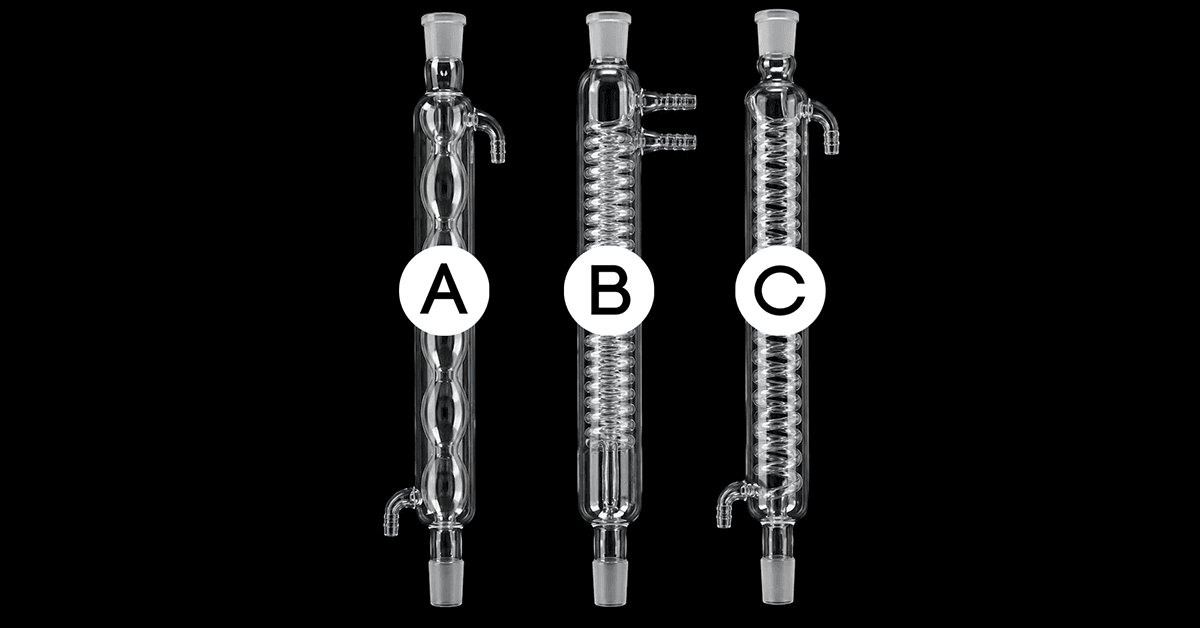
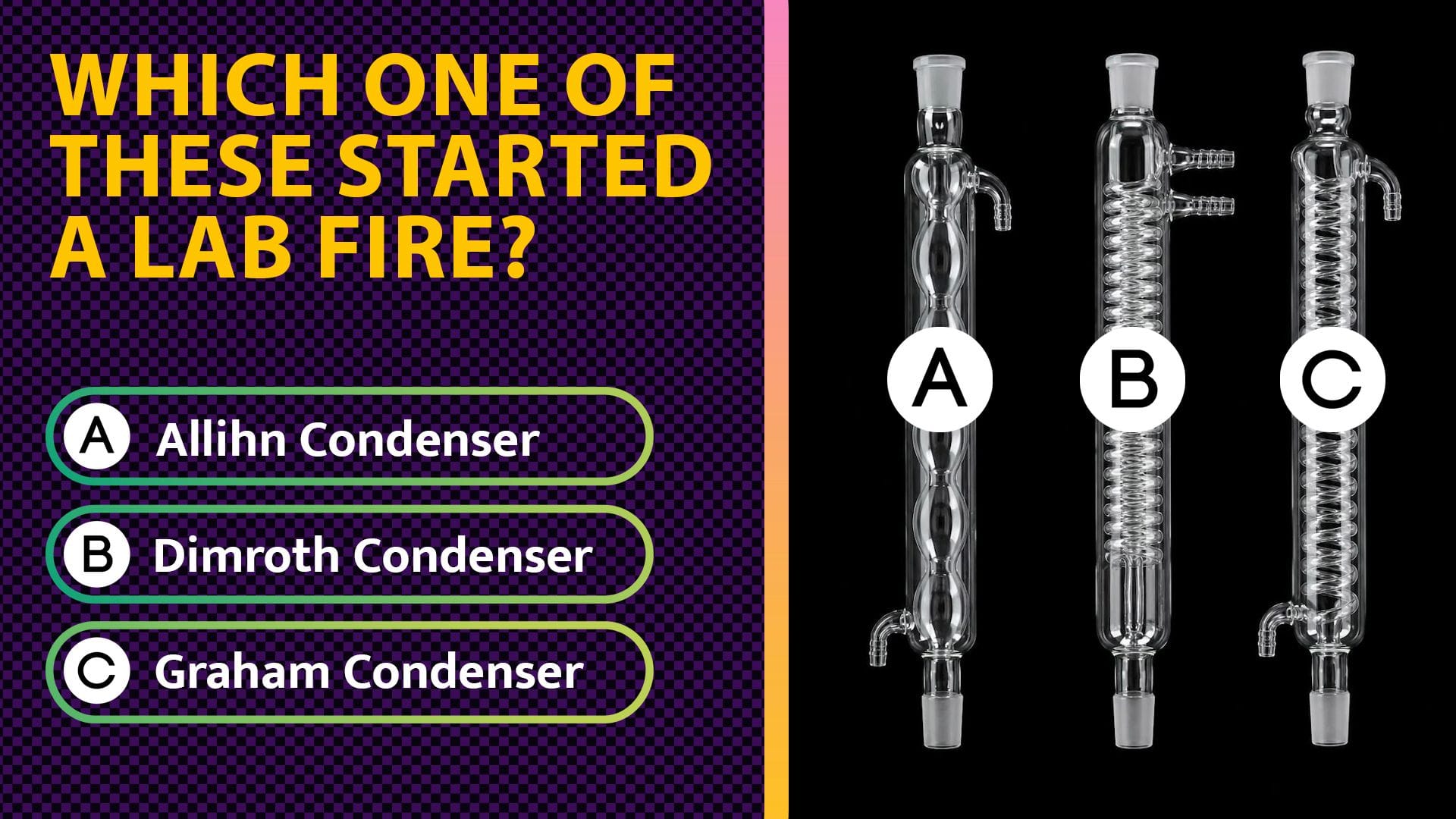
- The experiment used a Graham condenser, whose narrow internal spiral can flood under higher vapor loads.
- The fume hood was not operating, allowing flammable vapors to accumulate more easily.
- The transformer was not explosion-proof.
- The distillation was left unattended.
- Fresh carbon disulfide was added while the heating system remained on.
The researchers believe the overpressure event itself was likely caused by flooding within the Graham condenser. As condensate accumulated inside the condenser's narrow spiral, it could no longer flow downward efficiently against the rising vapor stream. The resulting blockage increased pressure inside the flask until a stopper was forced loose.
An overlooked factor in risk assessment: the condenser
The condenser became a key focus of the investigation. Many chemists choose Graham condensers because their coiled design provides a large cooling surface area, but cooling efficiency is only part of the equation. The researchers argue that condenser selection should account for both condensation efficiency and the movement of vapor and condensate through the system.
To test their hypothesis, the team conducted follow-up experiments comparing different condenser designs. They observed flooding in a Graham condenser under conditions similar to those used in the original distillation. By contrast, an Allihn condenser operated without flooding, even at higher temperatures.
The findings suggest that condenser choice should be considered alongside factors such as heating rate, vapor production, and pressure relief when planning a distillation or reflux experiment.
Four Common Condensers at a Glance
Liebig Condenser
Best for: Simple distillations and lower vapor rates.
Consideration: Provides the least cooling surface area of the condensers discussed in the study.
Allihn Condenser
Best for: Reflux and redistillation.
Consideration: In the researchers' tests, the Allihn condenser did not flood under conditions that caused flooding in the Graham condenser. Should be used vertically.
Graham Condenser
Best for: Light-load applications, such as recovering vapor from permanent gases.
Consideration: Its narrow internal spiral can flood at higher vapor rates, increasing the risk of pressure buildup. The authors do not recommend it for reflux or redistillation setups.
Dimroth Condenser
Best for: Reflux and redistillation.
Consideration: Provides the largest cooling area among the condensers discussed and has the highest reported flood point.
Key takeaway: When selecting a condenser, consider both cooling performance and how easily condensate can return against the vapor stream. According to the authors, condenser choice should be part of every distillation risk assessment.
What students missed
The accident later became a discussion topic in the university's open online course, Safety in the Chemical Laboratory. Students were asked to identify the causes of the fire. Many pointed to the unattended experiment, the flammability of carbon disulfide, the inactive fume hood, or the oil bath temperature. However, only 2.5% identified the condenser selection itself as a contributing factor.
For the researchers, that result highlighted an important gap in laboratory risk assessment. Equipment selection is often treated as a routine decision, yet it can significantly affect how safely a system operates under real-world conditions.
The authors conclude that evaluating the entire experimental setup, including condenser design, is an essential part of planning a safe distillation. As this incident demonstrates, laboratory accidents rarely stem from a single mistake. More often, they result from multiple factors interacting in ways that are not immediately obvious until something goes wrong.
Watch more Headline Science on YouTube!
The video above is brought to you by the ACS Science Communications team. To watch more exciting videos and shorts covering some of the latest research in ACS journals, visit the Headline Science page on YouTube.
Video Credits:
Written, produced, and hosted by Lizette Miranda
Editing and animations by Janali Thompson
Filmed by Darren Weaver and Janali Thompson
Series produced by Vangie Koonce, Anne Hylden, Andrew Sobey, Janali Thompson, Elaine Seward, Darren Weaver, and Jefferson Beck
Executive produced by Matthew Radcliff
Research videos from Hongyan Feng, Ph.D.
Explore related articles from ACS Chemical Health & Safety
Lessons Learned─Heat Gun Fire
Craig A. Merlic*, Sarah R. Zinn, and Imke Schröder
DOI: 10.1021/acs.chas.4c00007
Lessons Learned: Benzene Distillation Vapor Explosion and Fire
Amanda B. Chung*, Cy H. Fujimoto, and William J. Evans*
DOI: 10.1021/acs.chas.3c00033
The Importance of Fire Extinguisher Training among Graduate Student Laboratory Teaching Assistants: A General Chemistry Laboratory Fire Incident
Casandra M. Moisanu, Brayley S. Gattis, Benjamin R. Williams, Katherine A. M. Gesmundo, and Michael B. Blayney*
DOI: 10.1021/acs.chas.2c00094
Integrated Fault Tree Analysis and Bayesian Network for Fire Risk Assessment in University Laboratories
Yushan Zhao, Hui Liu*, Bingrui Tong, Cong He, and Junjie Zhu
DOI: 10.1021/acs.chas.5c00134
Making Safety Research Accessible to All
ACS strives to be a champion for safety in academia, research, and industry by communicating best practices and developing resources to support a culture of safety that can adapt to new technologies, workplaces, and global collaborations.
A clear demonstration of this commitment is the establishment of ACS Chemical Health & Safety as a Diamond Open Access journal earlier this year. This means that the impactful, peer-reviewed articles published in ACS Chemical Health & Safety from 2026 and onward are free to read by anyone, anywhere in the world. Furthermore, as of January 1, 2026, it is free to publish your research in ACS Chemical Health & Safety, with all editorial and publishing costs covered by ACS.