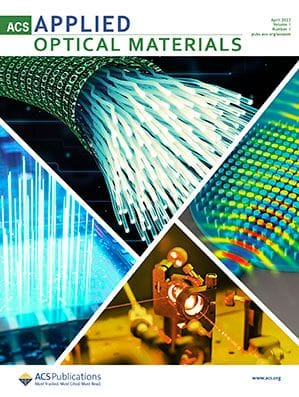
This Special Issue invites original articles that advance the design, characterization, and application of NIR-III optical materials and devices. Submit your manuscript by January 31, 2027.

The near-infrared third window (NIR-III, 1700-2500 nm) is emerging as a distinct frontier in optical materials science. Long-wavelength photons offer reduced scattering and background autofluorescence within selected spectral windows, opening opportunities in bioimaging, sensing, spectroscopy, nondestructive analysis, night vision, and infrared photonics. Efficient NIR-III emission nevertheless remains difficult because small energy gaps intensify multiphonon relaxation, weak excitation, thermal quenching, and device-integration constraints.
This Special Issue for ACS Applied Optical Materials invites original research articles, letters, reviews, spotlights and perspectives that advance the design, characterization, and application of NIR-III optical materials and devices. Studies linking host-lattice chemistry, excited-state dynamics, quantum efficiency, thermal stability, and device-level performance are especially encouraged.
Topics include, but are not limited to:
- New phosphors and luminescent materials emitting beyond 1700 nm
- Negative-thermal-expansion hosts, ceramics, glasses, phosphor-in-glass, and composites
- Lanthanide- and transition-metal-activated NIR-III systems
- Quantitative photophysics: IQE/EQE, absorption cross-section, lifetime, T50, and thermalquenching
- Host-lattice engineering: phonon energy, rigidity, site symmetry, and defect chemistry
- High-power excitation, thermal management, reliability, and device integration
- Energy transfer, sensitization, cross-relaxation, and concentration quenching
- NIR-III bioimaging, sensing, spectroscopy, communications, food analysis, and testing
- Chemical substitution, crystal-field tuning, nanostructuring, and surface/interface engineering
- Detector calibration, measurement standards, and characterization across 1700-2500 nm
Organizing Editors
Prof. Ru-Shi Liu, Associate Editor, ACS Applied Optical Materials
National Taiwan University, Taiwan
Submission Information
We welcome submissions for this Special Issue through January 31, 2027. For more information on submission requirements, please visit the journal’s Author Guidelines page.
Accepted manuscripts for consideration in this Special Issue will include research articles, letters, reviews, spotlights and perspectives. Papers accepted for publication for this Special Issue will be available ASAP (as soon as publishable) online. After all submissions have been published, they will be compiled online on a dedicated landing page to form the Special Issue. Manuscripts submitted for consideration will undergo the full rigorous peer review process expected from ACS journals.
Open Access: There are diverse open access options for publications in American Chemical Society journals. Please visit our Open Science Resource Center for more information.
How to Submit
- Log in to the ACS Publishing Center.
- Select your manuscript type; upload your manuscript and related files.
- Review the title and abstract fields to ensure any pre-populated information has uploaded correctly.
- Under “Special Issue Selection,” select Beyond 1700 nm: Materials, Mechanisms, and Devices for NIR-III Photonics.
- Confirm all other information has uploaded correctly.
- Submit your article.
If you have any general questions regarding submission to this Special Issue, please contact Dr. Chengmei Zhong (managing.editor@aom.acs.org).
Get e-Alerts
Stay Connected With ACS Applied Optical Materials
Never miss an issue again! Sign up now for email updates on future calls for papers, the latest articles, and other content from ACS Applied Optical Materials.