Researchers have developed a leather-like material from fungal fibers using a production process designed with large-scale manufacturing in mind.
Cow leather's carbon footprint is estimated to be substantially higher than that of many vegan alternatives, and there is growing interest in developing materials that reduce reliance on both animal agriculture and fossil-derived plastics. More careful use of natural resources and the development of circular material value chains are necessary for long-term environmental and economic resilience.
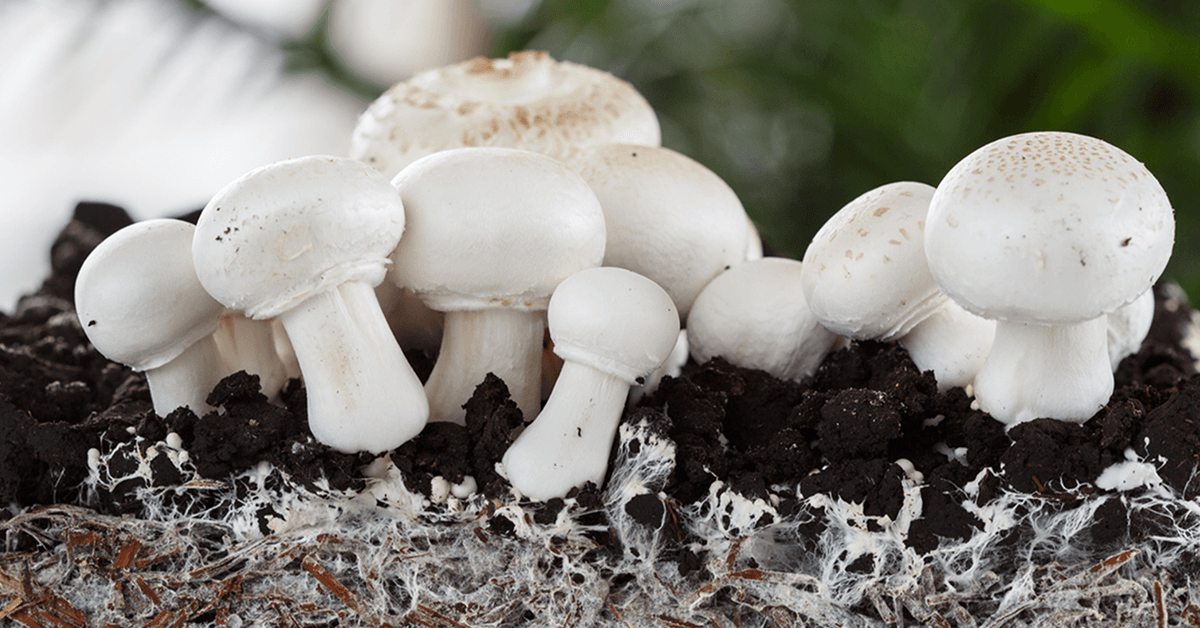
One promising option is fungal mycelium, the branching network of fibers that forms the main body of a fungus. Mycelium can act as a binding material in composites or as a fiber source for nonwoven fabrics. But despite its potential, the applicability of mycelium-based materials is still limited by production scale and material performance.
Mycelium can be grown in several ways:
- Solid-state fermentation produces composites or foam-like sheets.
- Liquid surface fermentation produces sheet-like mycelium pellicles.
- Submerged liquid fermentation produces a pulp-like suspension of fungal biomass.
Submerged fermentation has been used industrially for decades and is relatively straightforward to scale, although compared to solid-state methods, it requires further downstream processing. But those extra steps also create opportunities to tailor a material's properties, including its flexibility, texture, color, and strength.
Scaling up mycelium materials
A recent paper published in ACS Applied Bio Materials investigates the use of mycelium from submerged bioreactor cultivations of Trichoderma reesei to produce leather-like nonwoven sheets. The researchers selected the fungus because it forms a fine, pulp-like biomass with good water retention and colloidal stability, properties that can be useful during material formation.
Rather than growing sheets directly, the researchers cultivated the fungus in liquid-filled bioreactors, harvested the resulting biomass, and blended it with additives before forming thin sheets. They also explored manufacturing approaches that could support larger-scale production and demonstrated finishing techniques such as coloring, embossing, and layering the material onto cotton fabrics.
The mechanical properties of the resulting sheets depended strongly on how the mycelium was processed. Mycelium alone formed brittle sheets, but adding sorbitol improved flexibility. Nanofibrillated cellulose provided additional reinforcement, increasing tensile strength and helping the material achieve values comparable to those reported for some traditional leathers. Certain washing and pretreatment steps improved performance further.
To explore end-of-life options, the team evaluated how the material behaved in biodegradation and composting tests. In aquatic biodegradation experiments, the mycelium material showed 77% biodegradation after 28 days. Under industrial composting conditions, the sheets completely disintegrated in about 6 weeks. In comparison, cow leather and PVC-cotton materials degraded more slowly under the tested conditions.
A fun(gi) fashion experiment
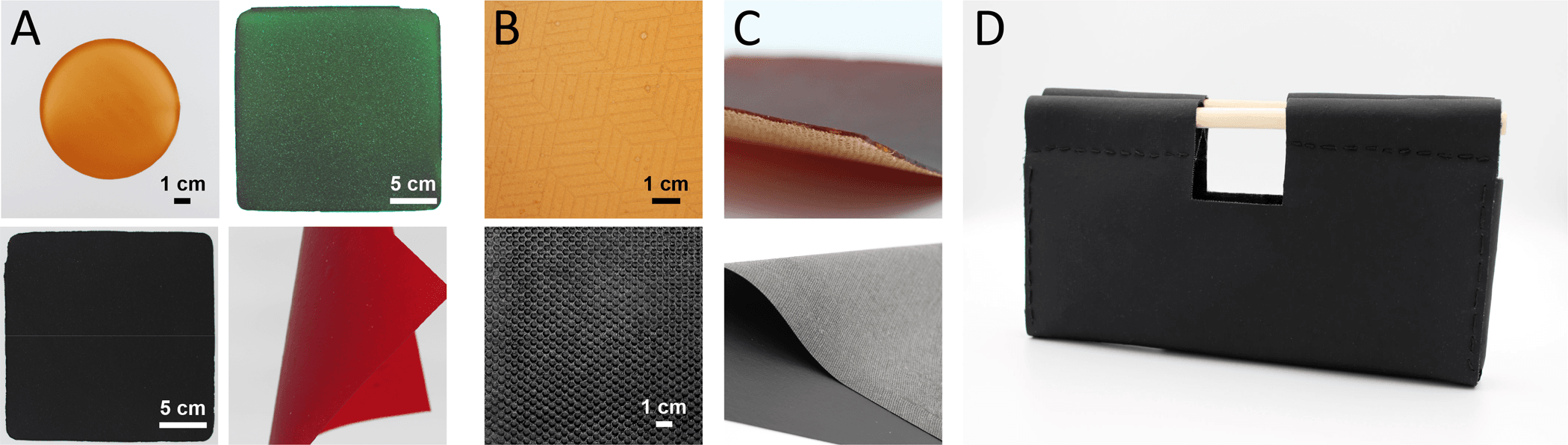
The researchers also used the material to produce a prototype handbag, demonstrating that the sheets could be cut, sewn, colored, and textured. To assess manufacturing potential, they produced continuous mycelium sheets approximately 8 inches (20 centimeters) wide and 26 feet (8 meters) long using a roll-to-roll casting process similar to equipment already used in paper, printing, and biotechnology industries.
Your next handbag probably won't be made from mushrooms just yet, but the work suggests that mushroom-derived materials may have a future beyond laboratory demonstrations. Whether they end up in handbags, vehicle interiors, or other everyday products, the study offers a glimpse of how fungal fibers could be transformed into materials at a scale that makes wider adoption possible.
Browse related articles in ACS journals
Biovegan Leather Sensor: A Mycelium Functionalized Material for Electrophysiological Signal Monitoring
Rui Zhang; Siyuan Cheng; Zaifeng Pan; Fenghui Yang; Yunqing Liu; Ruifa Su; Baoli Zha; Ruijie Xie; Bing Zheng; Jiansheng Wu; Fengwei Huo
DOI: 10.1021/acsami.5c05377
The Carbon Footprint of Leather: A Comprehensive Reassessment Using Global Livestock Data and Meta-Analysis
Mikaila K. Roncevich; Matthew N. Hayek; Juan P. Hinestroza
DOI: 10.1021/acssuschemeng.5c12631
High-Strength and Biodegradable Mycelial Leather Materials Cross-linked with Dialdehyde Carboxymethyl Cellulose
Rongquan Xu; Wei Wu; Yi Zhong; Linping Zhang; Hong Xu; Zhiping Mao; Bolin Ji
DOI: 10.1021/acssuschemeng.5c02119
Development and Characterization of Pleurotus Fossulatus Mycelium-Based Composites for Biodesigned Textile Applications
Morgan N. Davis; Jilly Sal Greenberger; Jesse Heacock; Jane E. Stewart; Yan Vivian Li
DOI: 10.1021/acssuschemeng.6c02091
Valorization of Carrot Pomace into Mycelium-Based Paper for Packaging Applications
S. Najmeh Mousavi; Naba Kumar Kalita; Sunil Kumar Lindstrom Ramamoorthy; Minna Hakkarainen; Akram Zamani
DOI: 10.1021/acsomega.6c00730
Fungal Mycelium Films Engineered as Renewable Fibrous Materials for Drug Delivery
Khorshid Kamguyan; Loes van Dam; Marta Rubio-Huertas; Juliane Fjelrad Christfort; Laura de Vittorio; Lasse Højlund Eklund Thamdrup; Leonie Johanna Jahn; Morten Bo Søndergaard Svendsen; Morten Otto Alexander Sommer; Anja Boisen
DOI: 10.1021/acsami.5c24189

Get e-Alerts
Stay Connected With ACS Applied Bio Materials
Never miss an issue again! Sign up now for email updates on future calls for papers, the latest articles, and other content from ACS Applied Bio Materials.