New research shows how traditional featherwork artists combined both structural color and pigments to create a wider palette than previously understood.
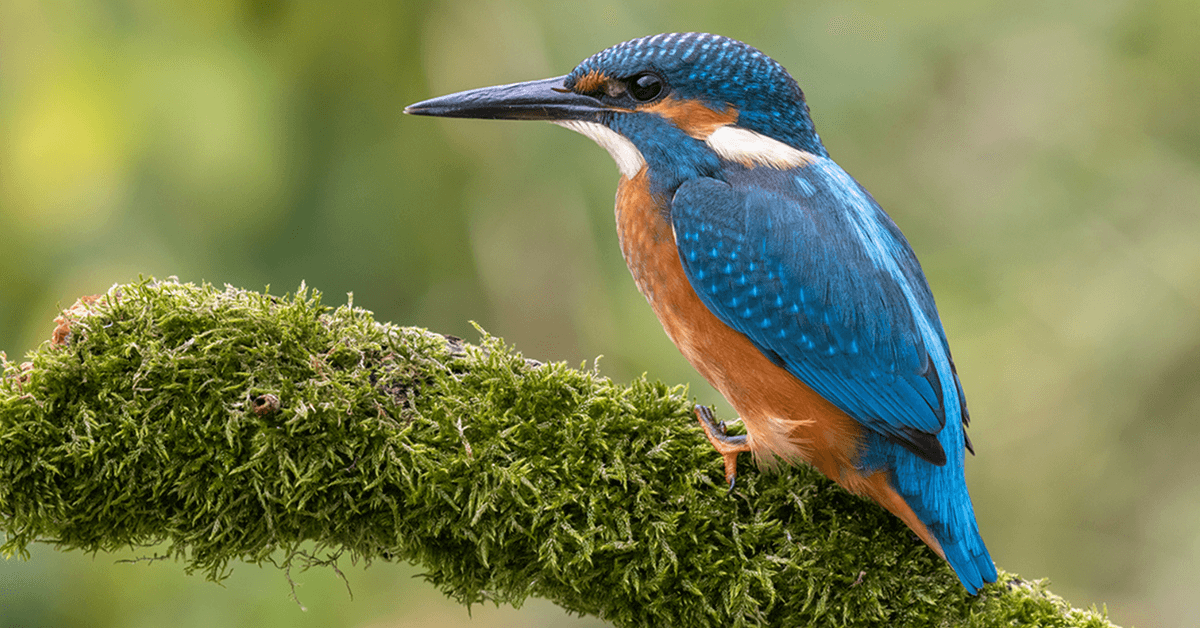
Tian-tsui is a Chinese art form dating back more than 2,500 years, in which the feathers of kingfisher birds were used to create detailed designs on objects ranging from metal jewelry to large wooden panels and screens. Individual feather barbs were either placed directly into adhesive on a surface or first attached to a backing and cut to shape.
Unlike dyes and pigments, some feather hues arise from structural color, a phenomenon in which tiny, ordered nanostructures within the feather scatter and reflect light to produce iridescent hues. In kingfishers, orange tones come from pigments, while the vivid blue and cyan are produced entirely by these nanoscale structures.
While tian-tsui is often associated with blue and purple kingfisher feathers, many surviving objects display a far broader range of colors. Understanding the materials used in artworks is important for conservation and for reconstructing historical techniques. Yet featherworks have received relatively little attention in cultural heritage science, leaving open questions about how these materials behave over time and how artisans achieved such a wide palette.
A closer look at tian-tsui materials
A recent ACS Omega study applies a multianalytical, largely noninvasive approach to examine these questions. Researchers analyzed 12 decorative screen panels using complementary imaging and spectroscopic methods, including hyperspectral imaging, to characterize both pigments and structurally colored feathers.
The results point to a surprisingly diverse set of materials. Blue feathers were identified as coming from the common kingfisher, while purple tones came from the black-capped kingfisher. Green feathers showed different nanostructures altogether and were attributed to mallard duck.
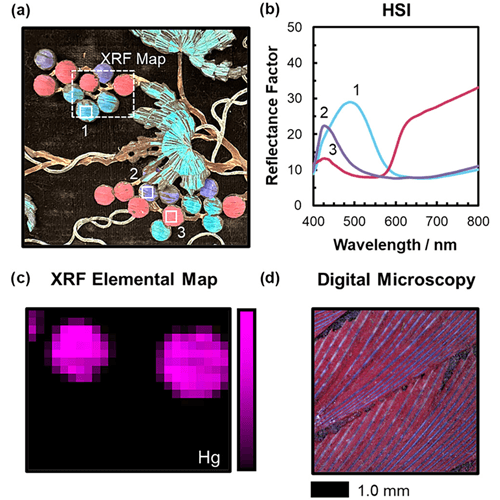
In one region, the team found that magenta tones, shown in the figure below, were produced through layering a red pigment, cinnabar (mercury sulfide), beneath purple feathers. This combination changes how light is absorbed and reflected, allowing artists to expand their color range beyond what feathers alone could provide.
The findings demonstrate how historical tian-tsui artists combined biological materials and mineral pigments to achieve specific visual effects. They also highlight a practical challenge for researchers, since orientation, lighting, and feather structure all influence how color is perceived.
Hyperspectral imaging: reading color one pixel at a time
Conventional analytical methods can struggle with feather materials because their reflectance shifts with viewing angle. Hyperspectral imaging, a method that collects images across many narrow wavelength bands, offers a way to address this challenge by producing a full reflectance spectrum for every pixel in an object.
This pixel-level spectral data allows researchers to map the distribution of materials without sampling. The technique has been used in other areas of cultural heritage and is now being adapted to better understand structurally colored materials like feathers.
In this study, hyperspectral imaging helped capture subtle variation across the panels and distinguish between different color mechanisms, even within visually similar regions.
Looking ahead: what we can still learn from featherworks
Because of conservation concerns and the environmental impact of sourcing feathers, techniques like tian-tsui are unlikely to be reproduced at scale today. Still, studying these objects helps inform preservation strategies and deepens understanding of how complex color systems were achieved in practice.
“Color in artworks and artifacts is a complex phenomenon occurring across material class and length scales from macro to nano,” notes Madeline Meier, the corresponding author of the paper. “It really illustrates the skill and material knowledge that went into fabricating these beautiful works.”
Meier and colleagues plan to extend these methods to other featherworks and to further investigate how nanoscale structures influence perceived color. Insights from these systems may also inform ongoing work in optics and materials science, where structural color remains an active area of research.
Chemistry and art: explore related articles in ACS journals
Broad Range Mid-IR Reflection Spectroscopy for Macroscale Standoff Hyperspectral Imaging of Paintings
Francesca Rosi*, Laura Cartechini*, David Buti, Francesca Sabatini, Aldo Romani, Diego Sali, Xia Wu, Roland Harig, M. Cristina Tomassetti, Brunetto G. Brunetti, and Costanza Miliani
DOI: 10.1021/acssensors.5c00865
Mass spectrometry maps the chemistry of a 1690 painting
Carolyn Wilke, special to C&EN
DOI: 10.1021/cen-10405-scicon5
A Workflow-Driven Multisensor Scanning System for In Situ Extensive Hyperspectral Chemical Imaging of Paintings
Lucilla Pronti*, Martina Romani, Antonella Balerna, Damiano Cappella, Stefano Tamascelli, Silvia Brandalesi, Alice Mantoan, Marco Angelucci, and Mariangela Cestelli Guidi
DOI: 10.1021/acs.analchem.5c04231
Electrochemical Impedance Spectroscopy Study of Water Uptake during the Removal of Polymer Coatings on Artworks
Isao Shitanda*, Yumiko Saito, Noya Loew, Taku Ogura, Kenji Kashimura, Masahiro Yoshino, Hidetomo Sekine, Hikari Watanabe, Masayuki Itagaki, and Piero Baglioni
DOI: 10.1021/acs.langmuir.6c00859
Unveiling Raphael’s Christ Blessing: Chemical Analysis Reveals Distinctive Underdrawing Techniques and a Rare Early Use of Egyptian Blue in Renaissance Art
Federica Pozzi*, Chiara Ricci, Mattia Morlotti, Daniele Demonte, Lisa Castelli, Chiara Ruberto, Costanza Cucci, Marcello Picollo, Lorenzo Stefani, and Marco Gargano
DOI: 10.1021/acsomega.5c11121
Mn/CeO2 Nanozyme Enables Effective Wall Painting Protection by Eliminating Reactive Oxygen Species
Wenting Gu, Junxia Ma, Yanrong Chen, Lei Zhong, Lixiang Zhang, Yanfei Wei, and Jingke Zhang*
DOI: 10.1021/acs.langmuir.5c03611
Get e-Alerts
Stay Connected With ACS Omega
Never miss an issue again! Sign up now for email updates on future calls for papers, the latest articles, and other content from ACS Omega.