
Whisky is known for its flavor and aroma, but the chemistry behind how it's made may also drive motion at the microscale.

During whisky distillation, sulfur-containing compounds in the liquid react with the copper walls of the still. These reactions help remove unwanted sulfur notes and shape the spirit’s final flavor profile. And in a recent study in ACS Applied Materials & Interfaces, researchers asked whether that same copper–sulfur reactivity could be used for a different purpose: to power motion at the microscale. To test the idea, they designed microscopic Janus particles and placed them in solutions containing sulfur compounds found in whisky.
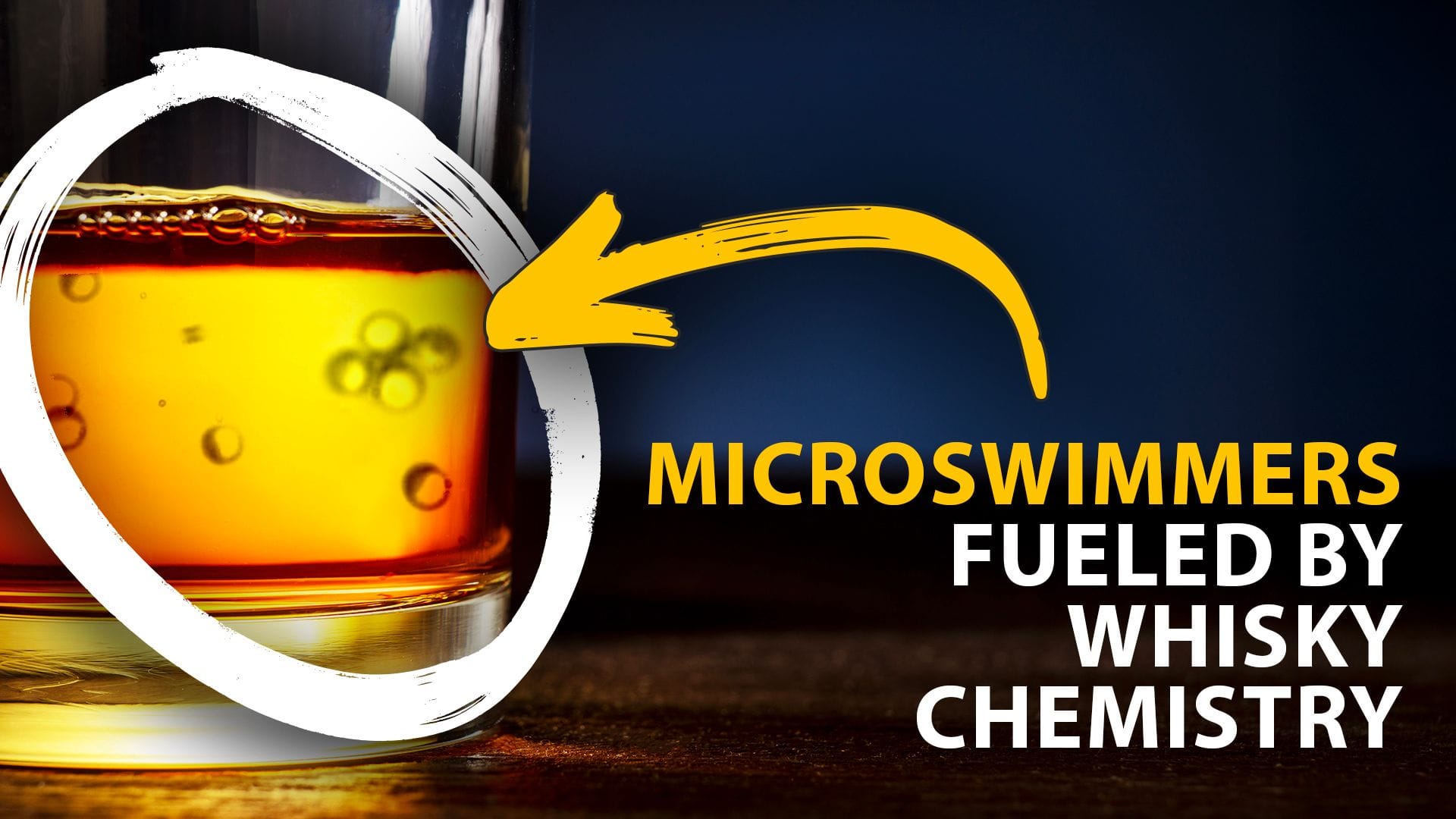
In the latest Headline Science video, a particle just a few microns across moves steadily through liquid, seemingly under its own power. The driving force comes from chemistry at its surface, where copper and sulfur compounds interact to create small but persistent gradients that keep the particle moving. Take a look at this whisky-inspired phenomenon:
Why copper and sulfur matter in whisky
Chemists have long been interested in whisky, how it's made, and the compounds that define its flavor. Making whisky starts with sprouting barley to release simple sugars, which are fermented by yeast into a liquid called a wash before being distilled to increase its alcohol content. Distillation in copper stills plays a central role, not just for heat transfer but for the chemical interactions that occur as the liquid passes through.
During this process, copper reacts with sulfur-containing compounds that can otherwise contribute off-flavors. The result is a complex mixture of compounds (sulfides, phenols, tannins, and esters) that reflects the details of production and aging. While sulfur compounds are part of the flavor profile at low levels, their reactivity with copper is key to keeping that balance in check.
How this chemistry can power motion
The researchers turned to a class of microscopic Janus particles, named for their two different faces. In this study, the researchers used silica spheres with a thin copper coating on one side. The particles' asymmetry is important because it allows chemical reactions to happen unevenly across the surface.
When the particles were placed in a solution containing dimethyl sulfide (one of the most abundant sulfur compounds associated with whisky), the copper side began to react and set the stage for motion. At the surface, copper oxidizes in water, releasing copper ions, which then interact with dimethyl sulfide to form dimethyl sulfoxide. As products diffuse away from the particle, they create small but continuous differences in concentration around it. Those differences drive fluid flow along the particle’s surface, effectively pushing it forward. Because the reactions occur primarily on the copper-coated side, the motion is directional rather than random.
To confirm this wasn’t just the random jostling that affects particles at this scale, known as Brownian motion, the researchers analyzed particle trajectories. Instead of the diffuse, wandering paths typical of Brownian motion, they observed more directed movement, consistent with an actively driven process.
A new class of fuel for microswimmers
Not all sulfur compounds produced the same effect. Among those tested, water-soluble aliphatic monosulfides, especially dimethyl sulfide, were the most effective, enabling particle speeds of up to 30 μm·s⁻¹. Increasing the concentration of dimethyl sulfide initially led to faster movement, as stronger chemical gradients formed, before leveling off at higher concentrations.
Other sulfur-containing molecules present in whisky, such as thiophene and thiazole, did not produce sustained motion under the same conditions.
Further analysis confirmed that dimethyl sulfide is oxidized during the process and that copper oxide deposits form on the particle surface. This points to a redox-driven mechanism that differs from more commonly used fuels, such as hydrogen peroxide.
By drawing on a well-known reaction from whisky production, this work expands the range of chemical fuels available for microswimmers. While the system operates in aqueous solutions rather than real whisky, it illustrates how familiar reactions can be adapted for entirely different applications at the microscale.
Watch more Headline Science on YouTube!
The video above is brought to you by the ACS Science Communications team. To watch more exciting videos and shorts covering some of the latest research in ACS journals, visit the Headline Science page on YouTube.
Video credits:
Written, produced, and edited by Vangie Koonce
Narrated and hosted by Emily Schneider
Filmed by Darren Weaver
Series produced by Vangie Koonce, Anne Hylden, Andrew Sobey, Janali Thompson, Darren Weaver, Elaine Seward, and Jefferson Beck
Executive produced by Matthew Radcliff
Research videos from Khalifa Mohamed, Ph.D., and Juliane Simmchen, Ph.D.
Explore related articles from ACS journals
Quantifying Photochemical Propulsion in Light-Powered Janus Micromotors
Katherinne I. Requejo, Cristhian Cañari-Chumpitaz, Vida Jamali, Ricardo Ruiz, A. Paul Alivisatos*, and Carlos Bustamante*
DOI: 10.1021/acsnano.6c00377
Impact of Phase-Separated Janus-Type Formation on the Reversibility of Multicomponent Exsolved Nanoparticles from Complex Perovskites
Blanca Delgado-Galicia, Andrés López-García, Catalina Elena Jiménez, Rosario Suarez-Anzorena, Marcus Bär, Virginia Pérez-Dieste, Ainara Aguadero, Jose A. Alonso, Inés Puente-Orench, Laura Almar, Alfonso J. Carrillo*, and José Manuel Serra*
DOI: 10.1021/acsnano.6c01371
Identification of Aging Markers and Volatile Compound Changes during Natural Aging of Commercial Whisky by HS–(SPME)–GC–MS
Guillaume Martinez, Jaqueline Gilmara Barboza Januário, and Jean-Michel Lavoie*
DOI: 10.1021/acsfoodscitech.5c01146
Trimodule Synergistic Janus Mesoporous Nanomotor for Photothermally-Enhanced Chemodynamic Therapy
Yanming Ma, Jia Jia, Yating Zhan, Minchao Liu, Mohamed F. Mady*, Tiancong Zhao*, and Xiaomin Li*
DOI: 10.1021/acsami.5c24723
From the Archives:
Changes in whisky stored for four Years
Peter Valaer and W. H. Frazier
DOI: 10.1021/ie50313a024
Characterization of the Key Aroma Compounds in an American Bourbon Whisky by Quantitative Measurements, Aroma Recombination, and Omission Studies
Luigi Poisson and Peter Schieberle*
DOI: 10.1021/jf800383v
SCOTCH WHISKY
Peter Valaer
DOI: 10.1021/ie50367a016
Changes in Whisky While Maturing
A. J. Liebmann and Bernice Scherl
https://pubs.acs.org/doi/10.1021/ie50471a021
