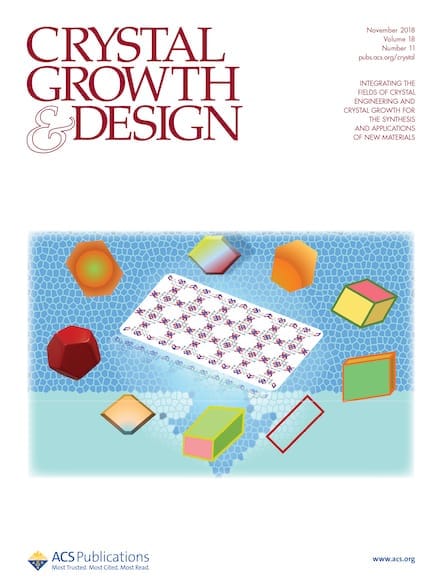
Scientists reveal how intermolecular forces allow layers within a crystal to slide under stress, allowing it to bend instead of break.
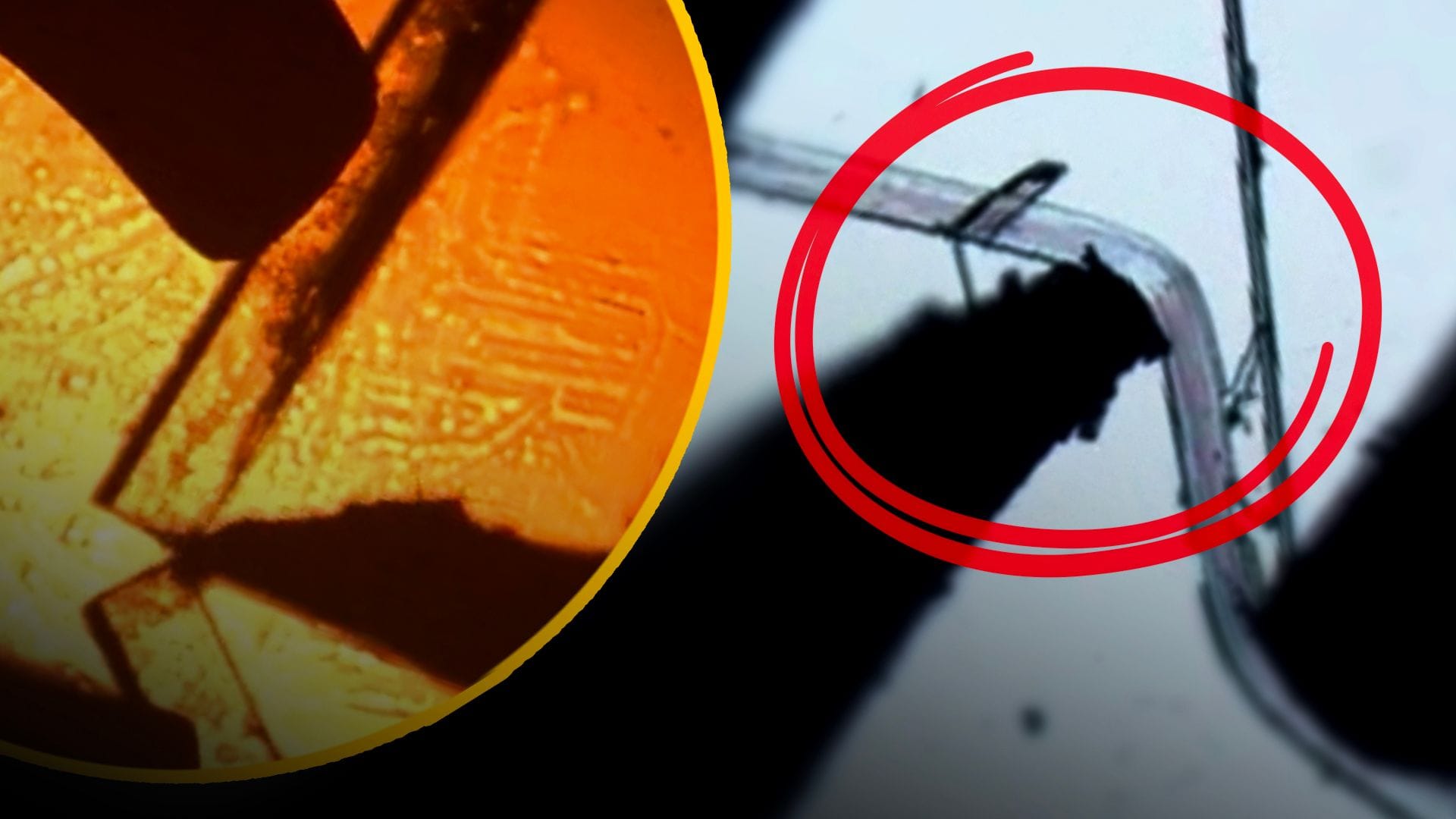
Molecular crystals are typically brittle—apply force, and they fracture. But in some cases, like the one captured in the latest Headline Science video, the internal structure of a crystal allows it to bend instead.
Scientists recently reported that crystals of 3-bromo-5-chlorobenzoic acid (3B5CBA) can bend plastically when stress is applied along a specific crystallographic face. The team selected this compound based only on its molecular structure and a hypothesis about how strong and weak intermolecular forces might interact—before knowing whether its crystals would actually exhibit plastic behavior. Their study, published in Crystal Growth & Design, provides the first detailed characterization of how this compound deforms, along with the first measurements of its mechanical properties, including hardness and elastic modulus.
Watch the crystals in motion:
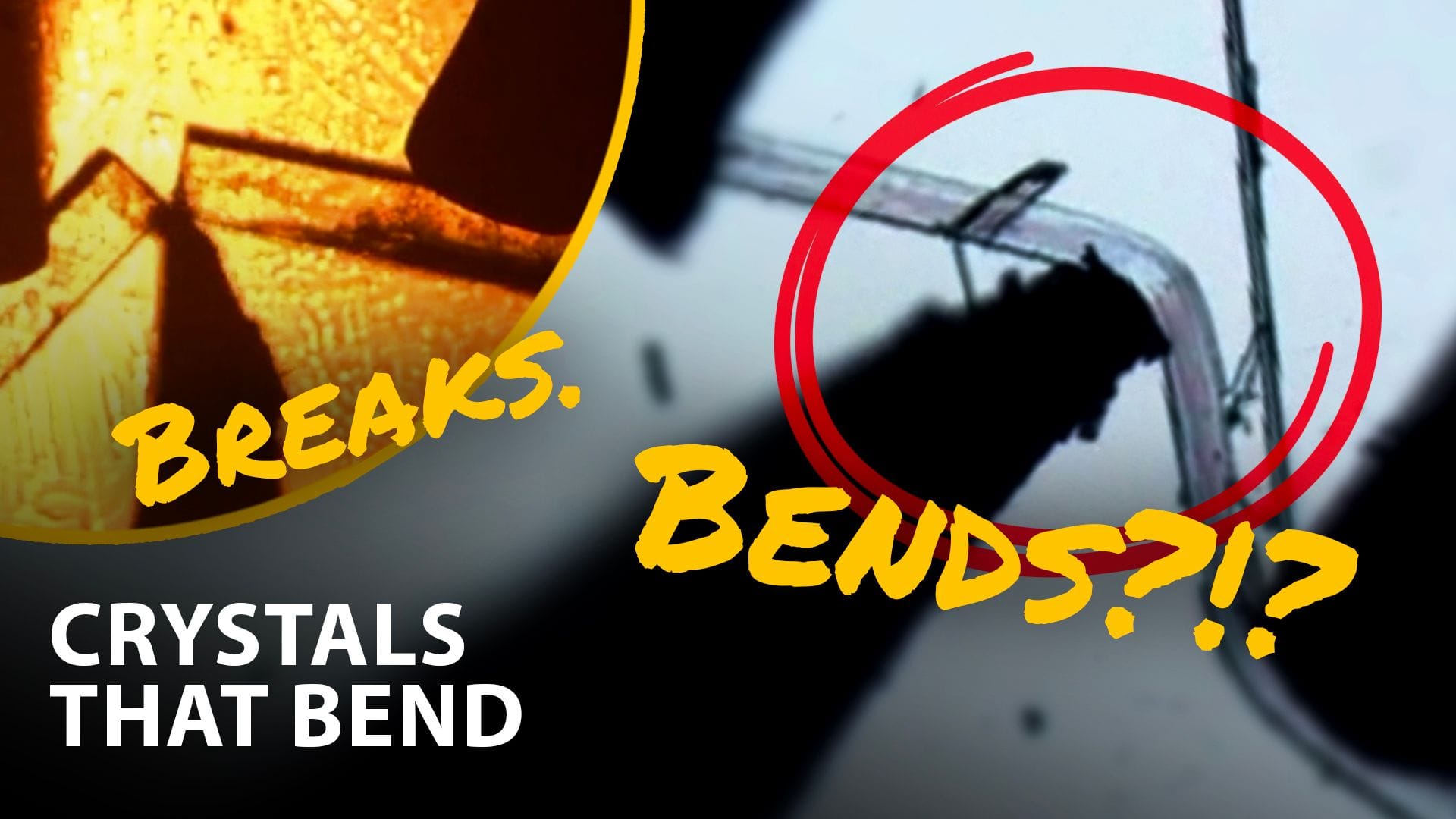
Their findings point to a structural origin for this behavior, rooted in how molecules are arranged and connected within the crystal. By linking molecular packing to mechanical response, the work helps clarify how flexibility emerges in otherwise rigid crystalline systems.
Why some crystals bend instead of break
Most crystalline materials fracture when deformed because their molecular structures resist movement. In contrast, some organic crystals can accommodate stress through their internal organization. Mechanical behavior depends on how molecules pack together and how they interact.
When strong interactions dominate in one direction and weaker ones in another, the structure becomes anisotropic. Weak interactions can act as buffers, allowing molecular layers to shift along slip planes under stress. This type of motion underlies plastic deformation, where the crystal retains its bent shape after the applied force is removed.
Previous studies have shown that both molecular shape and intermolecular interactions play a role in enabling this behavior. When these features align to create accessible slip planes, crystals can deform without fracturing.
The behavior observed in 3B5CBA reflects this type of structural arrangement. Crystals grown by fast evaporation formed long, needle-like structures that bent without fracturing when force was applied along a specific crystallographic face. When force was applied in other directions, the crystals instead showed brittle behavior, highlighting the importance of orientation. Thermal analysis showed that sublimation began at around 70 °C, before melting occurred at 195.3 °C.
Structural analysis linked this behavior directly to molecular packing. Molecules formed pairs through hydrogen bonding, and these dimers stacked through π–π interactions into ordered rows. As illustrated in the Headline Science video, these arrangements can be imagined as a kind of “double conga line,” where pairs of molecules link together and move in sequence. These rows are packed side by side, but the interactions between them are weaker, forming low-energy slip planes that allow adjacent layers to slide under stress.
Understanding these relationships is important for designing molecular solids with tailored mechanical properties. In pharmaceutical processing, plastically deformable crystals can improve compaction and tablet formation. In materials science, similar principles may inform the design of molecular systems that can withstand mechanical stress while maintaining structural integrity.
Watch more Headline Science on YouTube!
The video above is brought to you by the ACS Science Communications team. To watch more exciting videos and shorts covering some of the latest research in ACS journals, visit the Headline Science page on YouTube.
Video credits:
Written and produced by Anne Hylden
Editing and animations by Janali Thompson
Hosted by Anne Hylden
Series produced by Vangie Koonce, Anne Hylden, Andrew Sobey, Elaine Seward, and Jefferson Beck
Executive produced by Matthew Radcliff
Research videos from Deepak Rajput
Explore related articles from ACS journals
The Hidden Rules of Bendable Crystals: Quantifying the Energetics of Plastic Deformation at the Molecular Level
Aleksandr S. Dubok and Denis A. Rychkov*
DOI: 10.1021/acs.cgd.5c01744
Comprehensive Structure–Property Mapping of Tuned Mechanical Flexibility in Organic Cocrystals
Saikat Mondal*, Swayam Prakash, Birte Riechers, Robert Maaß, Franziska Emmerling*, and Biswajit Bhattacharya*
DOI: 10.1021/acs.cgd.5c01550
Single-Component Globular Systems Capable of Plastic or Elastic Deformation and Structural Transitions
Sanjay Dutta and Caleb D. Martin*
DOI: 10.1021/acs.cgd.3c00866
Superflexible Fluorescent π-Conjugated Organic Crystals: Synergistic Mechanical-Optical Properties and Molecular Engineering Insights
Chunyan Zhang, Jiayao Li, Feiqiang He, Zhi Gao, Yijing Xiang, Limin Zhou, Li Xu, Jerry. Y. Y. Heng, Yifu Chen, Shichao Du, and Jinbo Ouyang*
DOI: 10.1021/acs.cgd.5c01167
When Reality Defies Prediction: Polymorphism, Twinning, and Accordion Crystals
Amy V. Hall*, Alice C. Taylor, Natalie E. Pridmore, Aurora J. Cruz-Cabeza, David K. Smith, Niccolò Cosottini, Mark A. Fox, Amrita Chattopadhyay, Stefanos Konstantinopoulos, Daniel N. Rainer, Simon J. Coles, Nicholas Blagden, Qi Zhang, Leon Bowen, and Toby J. Blundell
DOI: 10.1021/jacs.5c22213