
In this interview, Dr. Yin discusses his current research, challenges in the field, and the exciting things we can expect from ACS Nanoscience Au as he begins his new role as Deputy Editor.

ACS Publications is excited to welcome Dr. Yadong Yin as the new Deputy Editor of ACS Nanoscience Au.
Dr. Yin is a Professor of Chemistry at the University of California, Riverside, with an affiliate appointment in Materials Science and Engineering. He received his B.S. and M.S. in Chemistry from the University of Science and Technology of China in 1996 and 1998, respectively, and then his Ph.D. in Materials Science and Engineering from the University of Washington in 2002. In 2003, he worked as a postdoctoral fellow at the University of California, Berkeley, and later at the Lawrence Berkeley National Laboratory, and in 2005 became a staff scientist at the LBNL. He joined the faculty at the University of California, Riverside, in 2006.
He is a recipient of a number of awards, including the Cottrell Scholar Award (2009), DuPont Young Professor Grant (2010), 3M Nontenured Faculty Grant (2010), NSF CAREER award (2010), NML Researcher Award (2016), Fellow of RSC (2016), MRS Fellow (2020), and ACS Langmuir Lectureship (2022). His research interests include the synthesis, self-assembly, colloidal and interfacial properties, and applications of nanostructured materials.
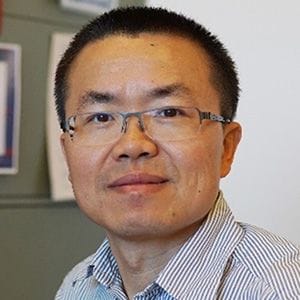
We recently caught up with Dr. Yin to learn more about his areas of study, what he hopes to bring to the journal as Deputy Editor, and some of his most rewarding research accomplishments.
What excites you about your current research?
The fusion of synthetic innovation and unprecedented functionality in hybrid nanostructures is what drives our current research. We are developing complex, multi-platform strategies that fundamentally break barriers and create synergistic properties inaccessible via conventional chemical synthesis. Our recent exciting success is a robust, generalizable strategy combining seeded growth and templating to produce hybrid nanostructures with potent dual magnetic and plasmonic properties. This unique capability is highly impactful, serving as the building blocks for cutting-edge technologies like novel sensors, soft robots, and smart materials. Now, we are expanding their reach to tackle major global challenges, from enhancing the cryopreservation of biological samples to the rapid degradation of persistent chemical pollutants.
What challenges did you have to overcome on your path to becoming who you are today?
My path was characterized by navigating intertwined financial, academic, and cultural hurdles. Growing up in rural China, the primary early challenge was my family's tight financial situation, which persisted through college, where I also struggled with a significant loss of confidence when comparing myself to exceptionally talented peers. This began to shift during my master's program as I discovered a passion and aptitude for research. Moving to the U.S. for my Ph.D. alleviated financial strain through scholarships, but introduced a steep challenge in overcoming the English language barrier—moving from exam-level knowledge to confident conversation took several years. As my career progressed, the focus shifted from research execution to securing resources and leading people: I had to master the art of convincing funding agencies of my research projects’ value and impact and learn to lead diverse graduate students and postdocs by recognizing their individual strengths and tailoring expectations and mentorship rather than expecting a uniform academic outcome.
What opportunities in your field excite you the most?
I am most excited by the opportunities in nanoscience that promise to fundamentally re-engineer established industries, especially the chance to develop smarter, more integrated, and more efficient solutions across several key areas. This includes revolutionizing healthcare with personalized nanomedicine and ultrasensitive biosensors for early detection, creating clean energy by designing next-generation nanomaterials for highly efficient solar fuels and energy storage, developing advanced materials with properties tailored atom-by-atom, and pioneering quantum technologies by using nanostructures as essential components.
What do you think is the most interesting or important unsolved problem in chemistry?
Artificial photosynthesis. It offers a singular, fundamental solution to the global energy and climate crisis. The core chemical challenge is designing robust, inexpensive photocatalysts that can efficiently mimic nature's process in using sunlight to convert water and stable carbon dioxide into storable, high-value solar fuels. Success requires a breakthrough in driving the two highly demanding half-reactions—water oxidation and CO2 reduction—to establish a truly circular carbon economy and provide unlimited clean fuel.
What do you hope to bring to the journal as Deputy Editor?
As Deputy Editor, I will guide the journal toward a future marked by scientific excellence, inclusivity, and global influence. Using my international experience, cross-cultural perspective, and commitment to diversity and innovation, I aim to cultivate an environment that values diverse scientific contributions, embraces global perspectives, and promotes nanoscience research worldwide.
What do you wish someone had told you when you were starting out as a chemist?
What I wish someone had told me when I was starting out as a chemist is that all the rules and laws have exceptions. In introductory chemistry, we are taught fundamental, discrete principles—reaction mechanisms, bond strengths, ideal gas laws—as fixed truths. While these are essential foundations, the real complexity and beauty of chemistry lie in the nuances: how often steric hindrance, solvent effects, or subtle electronic differences can completely override the general rules we memorize. I spent unnecessary time trying to force reality into textbook boxes. I wish I had understood sooner that the discipline isn't about rigid adherence to laws, but about learning to recognize the exceptions and use that deep understanding of context to successfully predict and design novel chemical outcomes.
Apart from chemistry, what are you passionate about?
Mountain biking. It’s funny because I was sedentary for most of my life and never imagined I’d love such an intense, high-focus sport. The pandemic gave me a chance to try it, and I've been completely obsessed ever since! Now, I have a collection of bikes in my garage, and I feel lost if I can't hit the trails after work. It serves as my essential release—it’s an incredible way to clear my head, manage stress, and ensure I come back to work the next day fully re-energized.
Stay Connected with ACS Nanoscience Au
Never miss an issue again! Sign up now for email updates on the latest articles, calls for papers, and other content from ACS Nanoscience Au.