
Inspired by the canine tongue, researchers designed a surface that continuously spreads and evaporates water to help manage heat without external pumping.
As electronic components become smaller and more densely packed, keeping them within safe operating temperatures becomes more difficult. Existing cooling strategies come with practical trade-offs involving heat transfer, energy use, noise, and integration. Air-based systems may become noisy when higher flow rates are needed, while liquid-based systems often rely on powered pumps.
Thin-film evaporative cooling offers another option. It removes heat as liquid changes into vapor and can operate below the boiling point without an external energy supply. Its performance, however, depends on maintaining a thin, stable layer of liquid. If the film becomes too thick, heat transfer slows; if it becomes too thin, the surface can dry out.
Sit, Stay, Evaporate
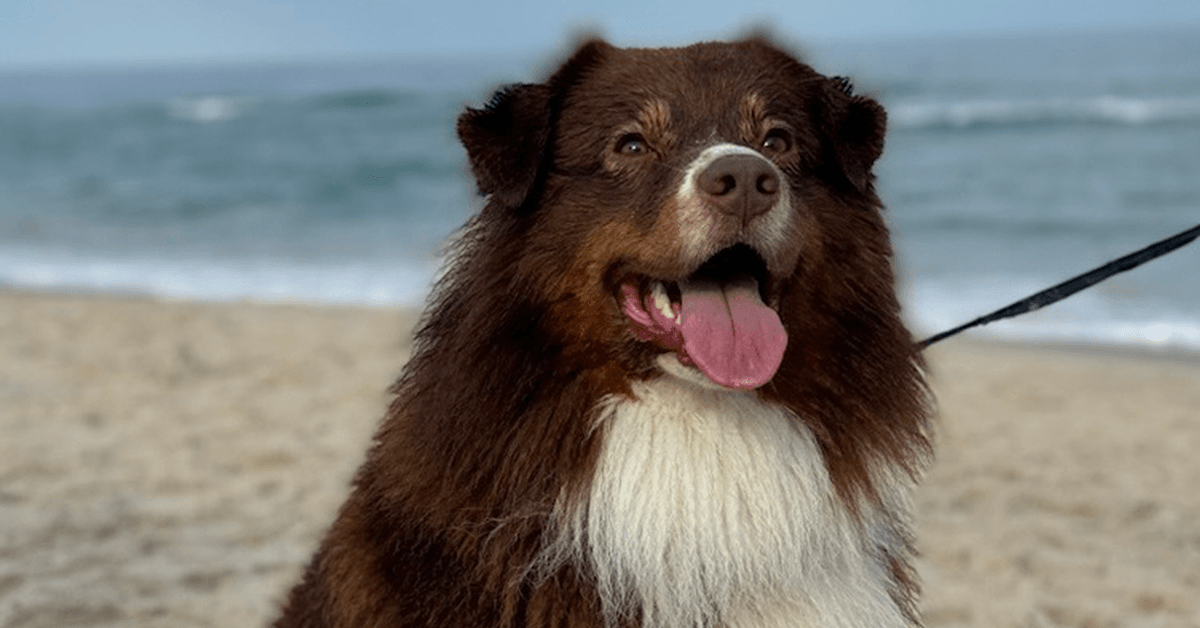
In a recent study published in ACS Nano, researchers turned to an experienced thermal manager: the canine tongue. Because dogs have few sweat glands, panting and the evaporation of saliva from the tongue play central roles in regulating body temperature. A steady supply of saliva keeps the tongue moist as evaporation occurs.
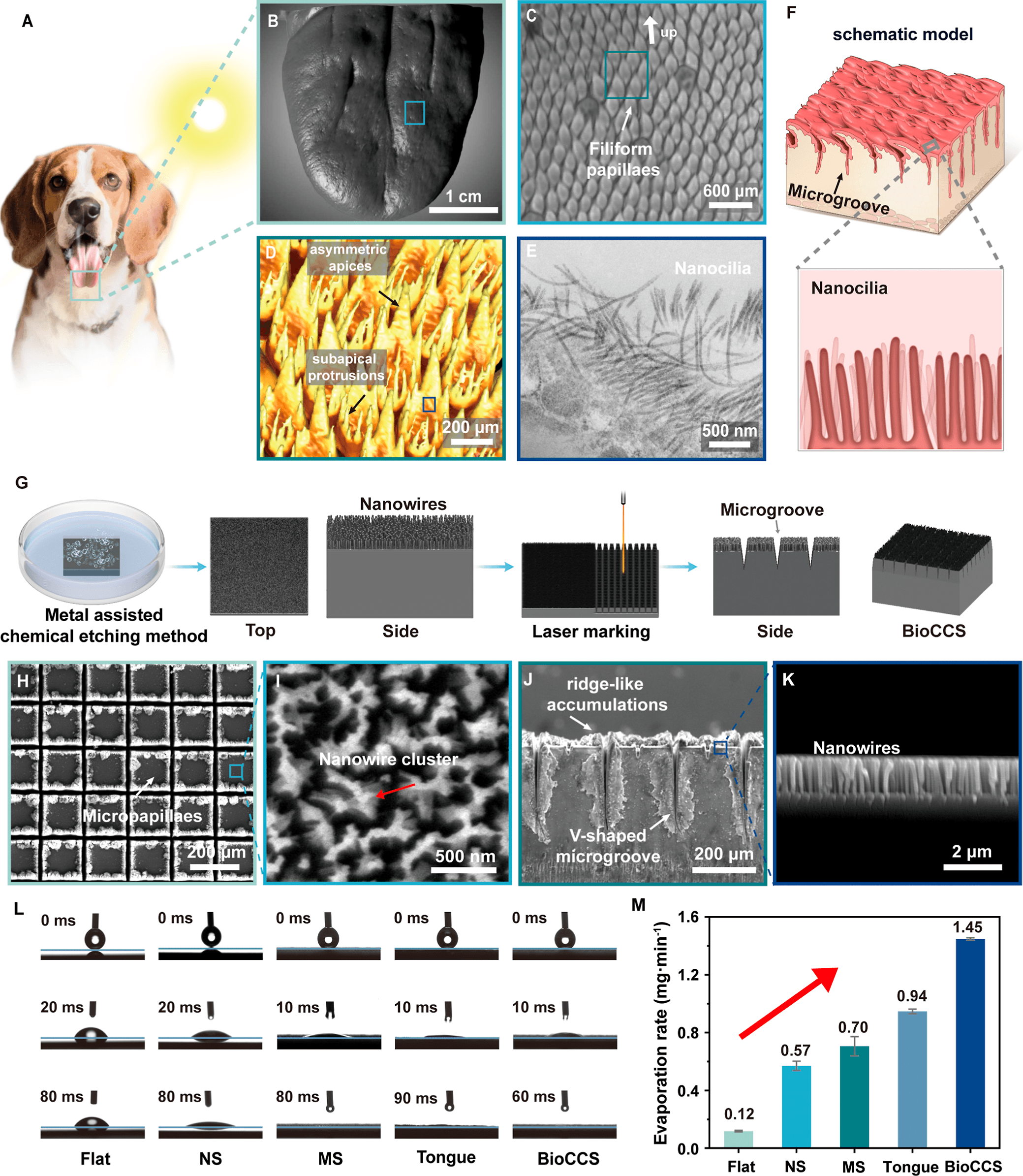
Using micro-computed tomography and electron microscopy, the team examined Beagle tongues at several length scales. Their analysis revealed nanosized, hairlike structures on the larger filiform papillae, a feature that had not been characterized previously. This arrangement combines structures at two different scales, creating pathways that may assist both saliva movement and evaporation.
The researchers used the tongue architecture as a model for an engineered silicon material they call a bioinspired cross-scale continuous surface, or BioCCS. The material pairs microscale grooves with arrays of nanowires. Capillary forces move water through the grooves, and the nanowires help distribute it into a more uniform layer.
Putting the Canine Design to the Test
The nanostructures also influenced water at the molecular level. Raman spectroscopy showed that BioCCS had a smaller proportion of strongly hydrogen-bonded interfacial water than flat, microstructured, or nanostructured comparison surfaces. The authors interpret this shift as evidence that water molecules face less resistance when leaving the liquid interface.
In droplet tests, BioCCS produced an evaporation rate 11.2 times that of a flat surface and 54% higher than the natural tongue. For a separate heated test, the researchers placed the lower portion of BioCCS in a water reservoir, allowing capillary action to supply the exposed cooling area. At 80 °C, BioCCS reached a mass flux of 31.36 kg h⁻¹ m⁻² and dissipated 150% more heat than the unmodified surface.
The model focuses primarily on the effects of physical structure, leaving questions about the role of surface chemistry for future investigation. For now, the study provides a solid framework for designing passively supplied evaporative surfaces for electronics and other technologies that rely on phase-change cooling.
Browse related articles in ACS journals
Rapid Thin-Film Evaporation with Nanoscale Transport Empowers Efficient Water–Energy Harvesting from Seawater
Meiwen Peng; Miao Wu; He Yang; Xinyu Zheng; Tianyi Wang; Rui Zhang; Bo Zhao; Lili Wang; Zhiqiang Liang; Tao Chen; Yinghui Sun; Zuankai Wang; Lin Jiang
DOI: 10.1021/acsnano.5c22215
The Control of Canine Halitosis By Sugar Cane Polyphenols: Effects and Potential Mechanisms
Hongye Li; Yin Fei; Wei Zhao
DOI: 10.1021/acs.jafc.6c00022
Smart Garment for Continuous Respiration Monitoring in Canines
Seokkyoon Hong; Taewoong Park; Youngjun Lee; Juan C. Mesa; Tianhao Yu; Yuhyun Ji; Junsang Lee; Jinheon Jeong; Seok-Won Kang; Dong Rip Kim; Young L. Kim; Hyowon Lee; Rachel K. Surowiec; Luis Dos Santos; Chi Hwan Lee
DOI: 10.1021/acssensors.5c03783
Headspace Particulate Measurements of Low Vapor Pressure Inorganic Oxidizers for Detection Canine Disciplines
Jason Jong; Trina Vian; Edward Charles Fortner; Mitchell W. Alton; Anita Avery; Geoff Geurtsen; Alla Ostrinskaya; John Jayne; Alexandra Wrobel; Ta-Hsuan Ong; Ted Mendum; Roderick Kunz
DOI: 10.1021/acsomega.5c12409
Olfaction in Dogs: Anatomy, Genomics, and Evolution
Yoshihito Niimura
DOI: 10.1021/bk-2026-1527.ch008
Get e-Alerts
Stay Connected With ACS Nano
Never miss an issue again! Sign up now for email updates on future calls for papers, the latest articles, and other content from ACS Nano.