Inspired by how skin cools through sweating, researchers designed a membrane that cools batteries by shedding water vapor and rehydrates by absorbing moisture from the air.

Heat is an unavoidable consequence of high‑performance lithium‑ion batteries. If not properly managed, that heat accelerates battery degradation and, in extreme cases, can escalate into thermal runaway events associated with fire or explosion risk. Engineers have spent years refining thermal management systems to keep battery temperatures in check, but many solutions rely on active cooling such as fans, pumps, or liquid loops that consume additional energy and space.
In a recent ACS Nano study, researchers took inspiration from a far more familiar cooling system: our skin. Just as sweating helps regulate our body temperature through evaporation, the team developed a passive cooling membrane that draws heat away from batteries by releasing water vapor and then quietly “recharges” itself by pulling moisture back in from the air.
Watch the membrane sweat it out in the latest Headline Science video:
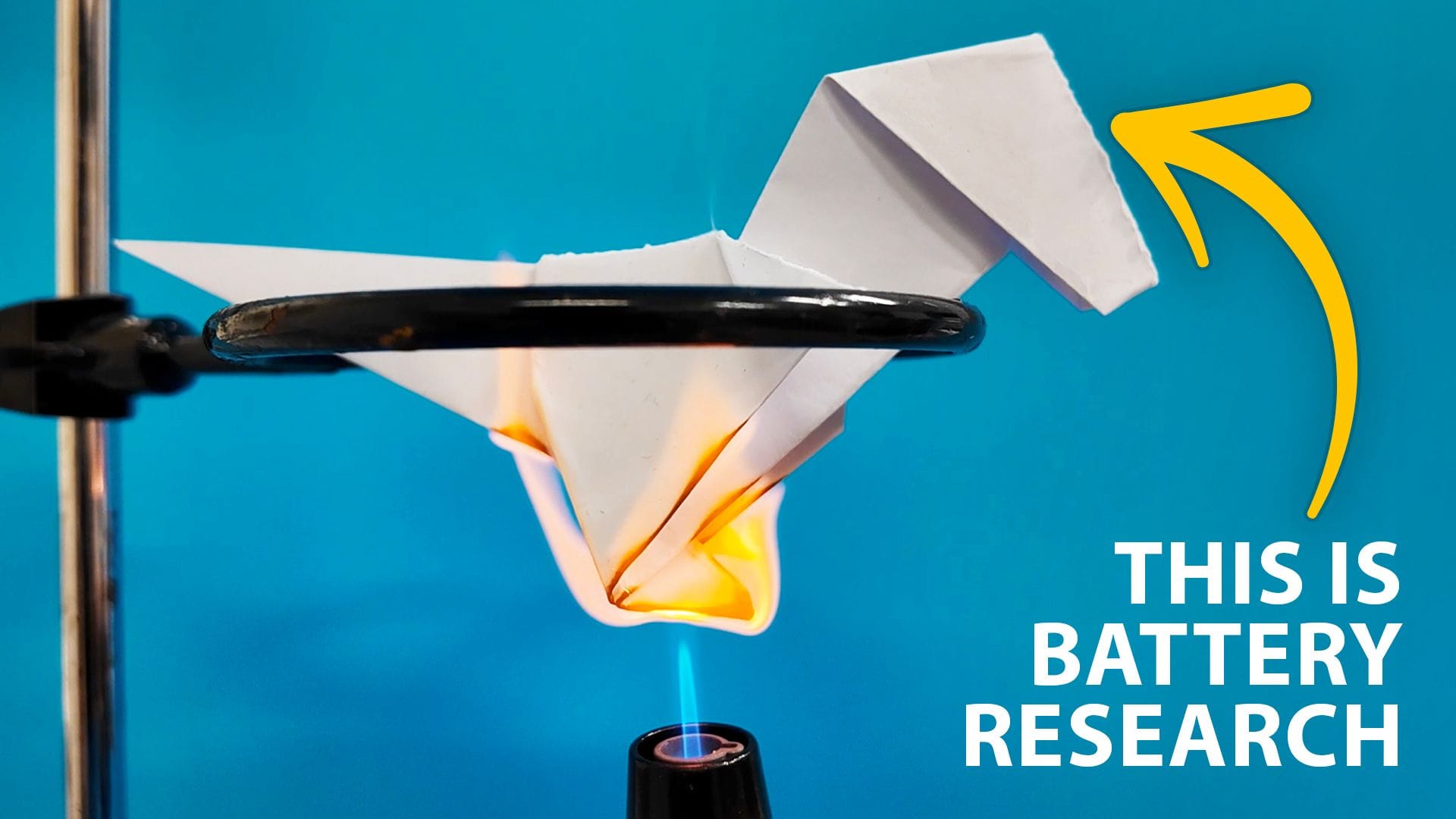
The membrane is built from a composite of lithium chloride, graphene oxide, and active carbon fiber, sealed inside a breathable yet waterproof porous layer. Lithium chloride readily absorbs water from humid air, while the carbon fiber provides a highly porous scaffold. Adding graphene oxide improves heat transfer through the material without compromising its ability to hold moisture. When a battery heats up, absorbed water desorbs and evaporates, carrying heat away in the process. As temperatures drop, the membrane naturally absorbs water again, restoring its cooling capacity without external input.
In controlled experiments, this evaporation‑driven approach delivered substantial cooling under heat loads comparable to aggressive battery charging and discharging. At higher heat fluxes, the membrane achieved temperature reductions exceeding 30 °C, with average cooling power that surpassed many existing passive strategies. When wrapped around a commercial lithium‑ion battery and tested at fast charge–discharge rates, the membrane kept operating temperatures noticeably lower than both unprotected batteries and those cooled with conventional phase‑change materials.
Under demanding cycling conditions, batteries equipped with the cooling membrane lasted nearly twice as many cycles before reaching end‑of‑life compared with uncooled cells. The composite also demonstrated strong flame resistance and maintained structural integrity during long‑term operation, reducing risks associated with leakage, corrosion, or fire propagation—persistent challenges for water‑based cooling approaches.
While real‑world deployment will still require careful integration and validation across different battery formats and environments, the authors are optimistic that their approach could offer a practical and cost‑effective pathway for passive battery thermal management.
Watch more Headline Science on YouTube!
The video above is brought to you by the ACS Science Communications team. To watch more exciting videos and shorts covering some of the latest research in ACS journals, visit the Headline Science page on YouTube.
Video credits:
Written by Kerri Jansen
Editing and animations by Janali Thompson
Tabletop origami videos by Anne Hylden
Narrated by Anne Hylden
Series produced by Vangie Koonce, Anne Hylden, Janali Thompson, Kerri Jansen, Andrew Sobey, and Jefferson Beck
Executive produced by Matthew Radcliff
Explore related content from ACS Publications
Dual-Functional Flame-Retardant Composite Phase Change Material for Thermal Management and Thermal Runaway Suppression
Han Lin, Zhubin Yao, Guoqing Zhang, and Xiaoqing Yang*
DOI: 10.1021/acsaem.5c01579
Double-Network Aerogel-Based Composite Phase Change Material Inspired by Beaver Damming for All-Weather Thermal Management of Lithium Batteries
Zaichao Li, Yupeng Hao, Feng Cao, Yuang Zhang*, Yanshai Wang, Shufen Zhang, and Bingtao Tang*
DOI: 10.1021/acsami.5c00342
Eco-Friendly Skin-Wrinkle-Inspired Micro-Nano Structured Cellulose Composite Fibers for Highly Efficient Daytime Radiative Cooling
Qihua Li, Jianfeng Li, Chen Zeng, Jingya Song, Yuchen Jiang, Haining Yu, Yu Fang, Shufeng Hu, Youwei Zhang, Weiqing Kong*, and Meifang Zhu
DOI: 10.1021/acsnano.5c06103
Research Progress on Thermal Runaway Mechanisms of All-Solid-State Lithium Batteries
Yan Cui, Weiguo Song*, Jianghong Liu, and Beihua Cong
DOI: 10.1021/acsenergylett.5c00503
Composite Phase Change Materials with Zn2+ Metal–Organic Gel and Carbon Microspheres for Battery Thermal Management
Peihui Chen, Xuxiong Li, Weifu Xu, Qing Deng, Yueyu Zeng, Gengfeng Zhao, Wensheng Yang, Zikai Guo, Guoqing Zhang, Zhizhou Tan, Xinkai Tang, Zhonghao Rao, and Xinxi Li*
DOI: 10.1021/acsaem.4c03266
Dual-Temperature Composite Phase Change Material Adapted for Wide-Temperature-Range Applications in Battery Thermal Management
Shuheng Hu, Liangke Mao, Peng Qin*, Zimu Xu, Lijian Ding, Helong Li, Ya Wei, Xiaoli Wang, Zhangyin Li, and Zhaozhong Huang
DOI: 10.1021/acsami.5c17887