
In this interview, Dr. Wongratanaphisan and Dr. Usulor describe their work on stable carbon-based perovskite solar cells, describe their experience publishing under Thailand’s nationwide read and publish agreement, and offer advice for first-time authors.

As part of an ongoing series here on ACS Axial, we’re interviewing authors and librarians from around the world to find out more about their research, their published work, and the impact that open science is having on a changing landscape of research communication. This time, we spoke with Duangmanee Wongratanaphisan and Chukwuebuka Emmanuel Usulor, researchers at Chiang Mai University, Thailand.
Open access has changed the way we think about sharing our research.
Tell me about your research group's current focus.
DW: Our group's focus is on developing efficient and stable carbon-based perovskite solar cells. We use passivation techniques to reduce defects and improve their performance and stability.
How would you summarize the work in your paper, “Surface Engineering-Induced 2D/3D Interfacial Reconstruction for Stable Low-Light Perovskite Solar Cells”?
DW: In this work, we use dibutylammonium bromide, or DBABr, to modify the interface between the perovskite absorber layer and hole-transport layer. This treatment induced 2D/3D interfacial reconstruction by forming a thin quasi-2D perovskite layer on the 3D absorber. These interfacial modifications suppressed ion migration and improved energy-level alignment, thereby facilitating more efficient charge attraction. As a result, the power conversion efficiency (PCE) increased from 13.82% for the control device to 15.52% under standard one-sun illumination.
Furthermore, the device achieved an impressive power conversion efficiency of 30.57% under indoor illumination at 1,000 lx, highlighting its potential for indoor photovoltaic applications, retaining approximately 90% of its initial efficiency after a thousand hours under ambient conditions.
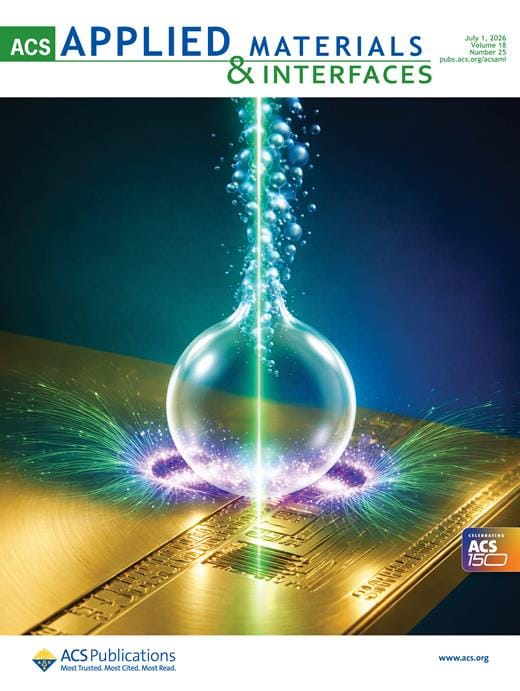
Read the Article
Surface Engineering-Induced 2D/3D Interfacial Reconstruction for Stable Low-Light Perovskite Solar Cells
Chukwuebuka Emmanuel Usulor; Woraprom Passatorntaschakorn; Sukhanidhan Singh; Warunee Khampa; Wongsathon Musikpan; Isaac Chinaza Ogbuagu; Nattawut Kamjam; Athipong Ngamjarurojana; Pisist Kumnorkaew; Anusit Kaewprajak; Pongsakorn Kanjanaboos; Pipat Ruankham; Duangmanee Wongratanaphisan*
DOI: 10.1021/acsami.6c09772
DOI: 10.1021/acsami.6c09772
What kind of feedback have you received from the community on this work?
DW: During early presentations of our work, we received questions such as how to control the thickness of the 2D perovskite layer. This can be achieved by varying the concentration of DBABr, in isopropanol and applying solutions of different concentrations to the surface of perovskite layer. By adjusting the DBABr concentration, we can control the formation and thickness of the 2D layer. This is an important consideration because an excessively thick 2D layer can act as an insulating barrier, hindering transport and negatively affecting the fill factor, ultimately leading to a lower power conversion efficiency. All of this was reflected in the published article.
This was published in ACS Applied Materials & Interfaces — what can you tell me about the experience?
DW: Publishing in ACS Applied Materials and Interfaces was a dream of ours. The peer review process was invaluable in improving the quality of our research — it highlighted the need for a major revision, which led us to being very happy with the final work. From submission to publication, the process took only about two months, which is very fast. Overall it was a great experience.
CEU: It was very good. The first time I submitted to an ACS journal it wasn't successful, so I was very glad this time that we were successful and that we could make the article open access.
The article was published OA under your institution's agreement with ACS — how did you discover this was available?
DW: Around two years ago, Thailand's Ministry of Higher Education, Science, Research, and Innovation and ACS Publications began an open access agreement that covers 78 universities, including ours.
I didn't know about the agreement at first; after I submitted to ACS Applied Materials and Interfaces I was contacted to let me know that the open access agreement was available,and then I decided to publish the article as open access.
What are your general thoughts on open access?
DW: Open access has changed the way we think about sharing our research. It allows more people to read and access our work without subscription barriers, helping our findings reach a wider audience and creating more opportunity for collaboration. I'm very happy that more people can read our work, and because our paper went through the usual peer review process, I feel very confident about its quality.
CEU: Open access means more people can access the paper freely, and be able to cite it. I keep getting notifications that people are reading the work. A previous publication of mine, which is not open access, gets much less traffic.
What are your thoughts on open science workflows more broadly?
DW: I think more people now see the value of sharing papers, data, so on. Open science help us learn from each other and open access allows everyone to read our work freely.
As an early career researcher, what advice would you offer first-time authors
CEU: I recommend that they take their time over writing the article to make it as strong as possible, and try to publish in open access. This will allow more people to read your paper, get more ideas from your work, and build on what you have done.
What do you think you'd be doing if you weren't a researcher?
CEU: If wasn’t working in research, I would probably be working in an electronics company. I have a passion for working on semiconductors; before I joined Prof. W's group, I worked in an electronics repair company, and I think that's what I would be doing if I wasn't working in this kind of research.
DW: I'm about to retire, but a lot of my effort is spent trying to provide a good environment for the next generation of researchers to produce their best work.
Open Science Conversations: View the Entire Series

Open Science Conversations: An Interview Series
This series features interviews with authors and librarians from around the world, providing insights into the importance of open science on the landscape of research communication.