
In this interview, Dr. Niamh Harbourne discusses her research on sustainable food systems and microgreens, institutional support for open access publishing, and the growing push toward transparency throughout the research lifecycle.

As part of an ongoing series here on ACS Axial, we’re interviewing authors and librarians from around the world to find out more about their research, their published work, and the impact that open science is having on a changing landscape of research communication. This time, we spoke with Niamh Harbourne, Associate Professor in the UCD School of Agriculture and Food Science.
When we're working in something like sustainability, where we're trying to address these huge global challenges, people need access to the information so we can all work together.
Could you tell me about the work in your paper, "Brassicaceae Microgreens: Phytochemical Compositions, Influences of Growing Practices, Postharvest Technology, Health, and Food Applications"?
The paper is a review article, synthesizing current knowledge about the Brassicaceae family of microgreens such as rocket, cress, broccoli, kale, and mustard. It brought together all the latest research on Brassicaceae microgreens, focusing on their nutritional and phytochemical properties — any of the factors that influence their quality from production to all the way through to post-harvest handling, their potential health benefits, and food applications.
The review shows how microgreens can be an important part of a sustainable and healthy diet, and it also highlights some of the challenges and opportunities for future research. As an example, one of the challenges with microgreens is their very short shelf life. They're very perishable products, rapidly losing quality and nutritional value after they're harvested. The review highlighted that there's a need for further research into post-harvest technology and storage strategies to try extend their shelf life and preserve their nutritional and phytochemical composition, which may help them become more widely more adopted as a food source.
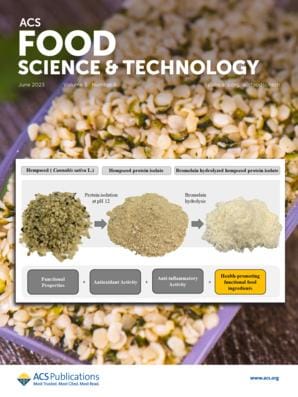
Read the Article
Brassicaceae Microgreens: Phytochemical Compositions, Influences of Growing Practices, Postharvest Technology, Health, and Food Applications
Belay Dereje, Jean-Christophe Jacquier, Caroline Elliott-Kingston, Mary Harty, and Niamh Harbourne*
DOI: 10.1021/acsfoodscitech.3c00040
DOI: 10.1021/acsfoodscitech.3c00040
That paper was published in ACS Food Science and Technology. How did you find that publication experience?
It was really good. The submission process was very straightforward, and we got very thoughtful reviewers' comments that really helped improve our work. It was included in a Virtual Special Issue aligned with the second UN sustainability goal. I think publishing in the special issue was a really good opportunity, because it gave the article greater visibility and promotion — the editors of the Special Issue actively advertised it through social media like LinkedIn, which helped highlight the paper and others in the area to people actively pursuing zero-hunger strategies.
What kind of feedback have you had from the community since the paper was published? Have you seen particular levels of citations or any interest from researchers contacting you directly as one of the authors?
I think, again, because it was published as part of a Virtual Special Issue, it might have benefited from additional visibility within the research community. It's attracted a significant number of views also citations, suggesting that it's been a useful resource for researchers working in the area of microgreens and sustainable food systems. It's also received attention from the horticultural industry — growers in Ireland reached out to talk to us about our work. It was also cited in some non-academic publications like a trade journal, and magazines and newspapers, so it got a wide range of attention.
You chose to publish this as open access, through your institution's agreement with ACS. How did you discover that option was available to you?
We're really lucky at UCD — our librarians are brilliant and keep us well-informed about open access, and actually open science in general. They do all sorts of outreach to discuss open science and how it affects people at all sorts of career stages. They regularly communicate the opportunities to all researchers through library updates.
We've got a number of open access agreements with publishers, some of which are metered — so we have a particular quota of articles that we can publish open access each year, depending on the journal or publisher. The library circulates that information regularly.
What are your thoughts on open access as a general concept for communicating science?
I think it's really, really important because it allows research to be freely accessible to everyone. That's obviously important for academic researchers, but also for uptake by industry. We also want to make sure that government policymakers and the general public, who fund our research, can all access without having to pay a subscription barrier as it was in the past.
I try and publish open access as much as possible — it increases the visibility of our work, and it's really important when we're working in something like sustainability or sustainable food where we're trying to address these huge global challenges, that people have access to all the information so we can all work together.
The only thing is the cost associated can be really high — in most cases these are covered by our institution's agreements, but if they run out of coverage, it can be a problem. In the past, I have submitted papers when we had open access coverage available, but by the time they've made it through peer review, all the OA funding has been used and all of a sudden you get a fee at the end. Sometimes our funding bodies will allow us to fund open access publishing in cases like that, but others won't — so it can really create challenges for researchers who want or need to make their work openly available, but don't have access to alternative funds to do so.
You mentioned that your institutional librarian reaches out to you, and keep you in the loop about open science workflows. Do you have any experience with open data, or, any other forms of open science?
I haven’t made use of open data yet. This is something I might want to do in the future. We make it available to other researchers if they ask, but we haven't systematically published it alongside our articles.
I've been involved in open peer review, and it's really interesting when you can see all the comments. It really shows you how the reviewers' comments shape the final publication, which can be a nice teaching tool for early career researchers who are still learning about the peer review process. Seeing the full life cycle is really interesting and useful.
Have you done any preprinting of your research?
No, I haven't had much experience of preprints. They're not really used that much in my area yet, although I think it's interesting to get early feedback on articles. I think there's a lot of challenges with preprinting as well, and I need to understand the ins and outs of it before we adopt it.
What do you think are the biggest recent developments around open science and open access?
I think it's really changing — it used to be that publishing the paper was the main goal, but there's been a real move towards being more open and transparent across the whole research lifecycle.
The rise of citizen science is really interesting and is becoming so important. I think actively inviting the public to participate in the research process can really help build trust in science and create a deeper understanding of the research process.
Open access is a concept that's been around for well over 20 years, but its adoption has undergone quite an acceleration in just the last 10 years. With that in mind, where do you think OA might be in about 10 years' time?
I think it's likely to become the default, rather than the exception in most fields — but there are a lot of things that need to be still sorted out. The current model of charging large fees to individual researchers isn't really sustainable, and it's going to kind of make the inequalities bigger: well-funded institutions will be able to support their researchers, whereas not as well-funded institutions won't, which will really deepen global equalities. So I suppose there'll have to be changes in the funding models.
I think we might also see stronger integration of open science practices across the whole workflow, with interlinked data, manuscripts, and maybe even per reviews published together in more standardized ways.
What do you think you'd be doing if you weren't a researcher?
I love research, but I used to always want to own a bookshop. I love reading books, so to have a nice, cozy bookshop sounds lovely. Maybe one day!
Open Science Conversations: View the Series

Open Science Conversations: An Interview Series
This series features interviews with authors and librarians from around the world, providing insights into the importance of open science on the landscape of research communication.