
In this interview, Dr. Chakthranont discusses her research on electrochemical energy technologies, reflects on the value of institutional open access agreements, and considers how funding realities influence participation in open science.

As part of an ongoing series here on ACS Axial, we’re interviewing authors and librarians from around the world to find out more about their research, their published work, and the impact that open science is having on a changing landscape of research communication. This time, we spoke with Dr. Pongkarn Chakthranont, a Senior Researcher at the National Science and Technology Development Agency (NSTDA), Thailand.
Open science should make research more accessible, but affordability remains a major barrier for many researchers.
What can you tell me about your group's research focus?
My group's focus at the National Nanotechnology Center (NANOTEC) in Thailand is on electrochemical systems for carbon capture and conversion, as well as biomass oxidation. One of the side projects that we have is development of oxygen reduction and oxidation by functional catalysts which we then demonstrate within devices such as zinc-air batteries. Electrochemical technology, catalysis, and electrochemical conversion are the main focus areas for our group.
How would you summarize the work in your paper, "Enhancing the Electronic Structure of Macroporous LaCoO3 through Ce and Ni Doping for High-Performance Bifunctional Electrocatalysts in Rechargeable Zinc-Air Batteries"?
We collaborated with a chemist who designed perovskite catalysts with different cation doping, and we found that this changed the electronic structure of the materials, improving catalytic activity for both oxygen reduction and oxygen evolution. This material can then be used as electrodes for a zinc-air battery. The paper demonstrates that the device doped with multiple elements can have higher stability and enhanced electrochemical activity.
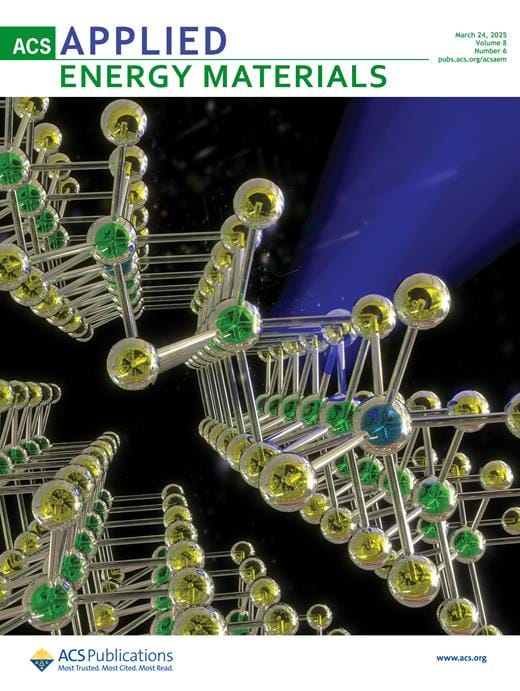
Read the Article
Enhancing the Electronic Structure of Macroporous LaCoO3 through Ce and Ni Doping for High-Performance Bifunctional Electrocatalysts in Rechargeable Zinc–Air Batteries
Sukit Boonlha; Tasanan Tirapanich; Ampawan Prasert; Sutasinee Kityakarn* ; Pongkarn Chakthranont*
DOI: 10.1021/acsaem.4c02918
DOI: 10.1021/acsaem.4c02918
What kind of impact do you think this paper has had in the 18 months or so since it was published?
This work itself is quite fundamental, because we started with catalyst development synthesis, and it's of quite a low TRL (technology readiness level) for now. But after publication, we've had some basic research labs at universities reach out to us for collaboration opportunities in trying to scale up these batteries and increase their functionality.
This was published in ACS Applied Energy Materials; what can you tell me about the experience?
I studied in the United States, and read ACS Publications journals a lot during that time, which means they're one of my favorites to read — and my favorite to publish in. I think the format they all use reads really well; it's easy to follow, and the journals are all well-known and read by colleagues in my institute and a lot of other universities.
The review process in ACS Publications journals is quick, typically a month or less, with maybe one or two rounds of revision. I think it's a fast and reasonable process in terms of the feedback we get.
Specifically for this article, we also published as open access because my institution has an OA agreement with ACS Publications that means we can choose the OA option without having to pay from our grant.
Where do you see OA in 10 years' time?
I think the amount of OA articles has increased a lot in the last 10 years, but at the same time there are a lot more journals. I think this combination skews some of the statistics for journals — a new open access journal might have a higher impact factor in a very short time compared to a prestigious and established hybrid journal where the impact factor is lower. In some countries this might not matter so much, but in Thailand, researchers and institutions still care about things like impact factors. Sometimes we have very rigorous research that's been through peer review many times and is very strong, but is cited relatively few times because it needs a subscription to read. It can be frustrating that we need to rely on these type of metrics.
So you feel like these metrics are a limiting factor in how researchers are assessed?
Yes. Sometimes it's not only about choosing where you would most like to publish, but where the impact factor is highest, which I really don't like.
I actually don't know how this system at would change. It would probably start by people publishing preprints and as open access, but there's a peer review burden there as well. Sometimes when I think about it, my rebellious side would be telling me not to publish at all! But that's not how the research world works — you need to publish, and you need the endorsement of being published in trustworthy sources. So I think there's the lasting dilemma of how we can get to a world of open science, and I'm really not sure how we'll get there.
What do you think you'd be doing if you weren't a researcher?
I've been working in a national lab doing foundational research for almost a decade. At first, the focus was on getting the best science published, and now it's much more about translating technology to industry all the way up to TRL9.
I think that if I wasn't doing this, I would still need to be involved in research somehow, perhaps in industry — I find the translation of research into application to be really intriguing and it's a big part of what drives me.
Open Science Conversations: View the Series

Open Science Conversations: An Interview Series
This series features interviews with authors and librarians from around the world, providing insights into the importance of open science on the landscape of research communication.