Stretch these polymer films and they change color! Researchers found that one small change to the surrounding material decides which color appears, and how the molecules inside break apart.
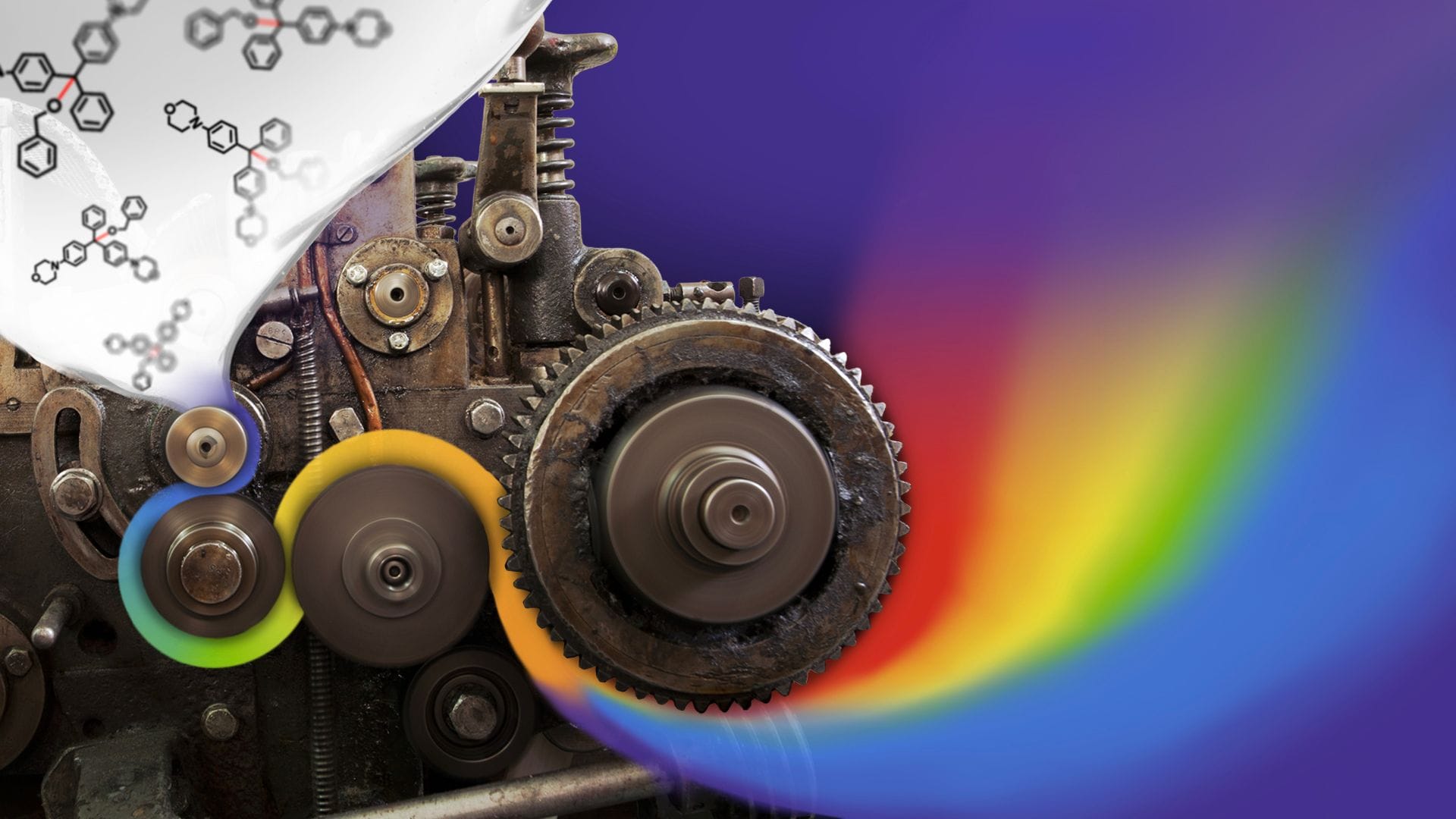
Stretch a plastic far enough and some of the chemical bonds inside it start to break. That damage is usually invisible, but in materials built with mechanophores — molecules designed to react to physical force — breaking bonds can instead produce a visible color change.
In a new study published in Macromolecules, researchers demonstrated that the same mechanophore can turn a film either orange or blue-green when stretched. The color that appears depends on a single ingredient in the surrounding plastic.
In this Headline Science video, watch the films change color and learn more about what’s happening to the bonds inside them.
Two Ways to Snap a Bond
A covalent bond can break in one of two ways. In homolysis, the shared electron pair splits evenly and each fragment leaves with one electron, forming radicals. In heterolysis, one fragment keeps both electrons, producing a pair of oppositely charged ions.
Solid polymers tend to favor homolysis. They have no surrounding solvent, and most are fairly nonpolar, so charged fragments have little to stabilize them. In 2021, members of the team showed that a triarylmethane mechanophore, the same one used in the new study, could split into ions inside a polymer containing hydrogen-bond donors. It was one of the few known exceptions. This new study asks whether that outcome can be controlled.
Hydrogen Bonds Make the Call
The researchers built the mechanophore into cross-linked acrylate films and varied the amount of an ingredient that donates hydrogen bonds. Hydrogen bonds can stabilize the negatively charged fragment that forms during heterolysis, so the team expected them to tip the balance toward ions.
Without hydrogen-bond donors, stretched films turned orange, consistent with radical formation. With 10% of the donor ingredient, they turned blue-green, the color of the triarylmethane carbocation. At 5%, both pathways appeared to operate at once. Electron paramagnetic resonance spectroscopy, which detects unpaired electrons, confirmed the pattern: strong radical signals in the orange films, weaker signals at 5%, and none in the blue-green films at 10%.
To rule out a general polarity effect, the team replaced the donor with a nearly identical ingredient that can’t form hydrogen bonds. Those films turned orange, just like the films with no donors, pointing to local hydrogen bonding as the deciding factor.
A second version of the mechanophore breaks at a carbon–carbon bond and carries a different leaving group. Because that group stabilizes a negative charge on its own, this version split into ions and turned blue-green even without hydrogen-bond donors, though it needed more stretching to activate.
What the Colors Could Tell Us
As far as the authors know, this kind of pathway switching had only been shown in solution before. They see the first mechanophore as a possible color-based sensor for hydrogen bonding inside polymers. They also acknowledge a limitation: because stretched films thin out and scatter light, optical measurements alone can’t measure how much of each pathway occurs.
The team has since extended these design principles to a related family of diarylmethane mechanophores in JACS Au. For a broader look at how mechanochromic materials are being developed for stress sensing and damage detection, see a recent review in Chemical Reviews.
Browse Related Articles in ACS Journals
Polymer Mechanochemistry: Where Is It Going?
Journal American Chemical Society (2025) 147 (34): 30529–30544
Isomer Effect of Double-Spiro Mechanophores in Polymer Mechanochemistry
Macromolecules (2026) 59 (17): 9877–9886
Asymmetric Double-Spiro Mechanophore in Single-Network and Double-Network Elastomers
Chem. Mater. (2026) 38 (10): 5276–5284
Regulation of Reaction Pathways in Coordinated Chains by Directional Mechanical Force
ACS Nano (2025) 19 (6): 6120–6129
A Guide to Tris(4-Substituted)-triphenylmethyl Radicals
Journal of Organic Chemistry (2023) 88 (14): 9893–9901
Polymer Mechanochemistry and the Emergence of the Mechanophore Concept
Macromolecules (2020) 53 (18): 7615–7617