
Get to know the 2025 winners and browse some of their recently published research in ACS journals.
The ACS journals ACS Macro Letters, Biomacromolecules, and Macromolecules, in partnership with the Division of Polymer Chemistry, are proud to announce the winners of the 2025 ACS Macro Letters/Biomacromolecules/Macromolecules Young Investigator Award:
- Prof. Guillaume De Bo, University of Manchester, United Kingdom
- Prof. Julia Ann Kalow, Northwestern University, United States
This award recognizes two outstanding early career investigators conducting research in any area of fundamental polymer or biopolymer science. Professors De Bo and Kalow will be honored during an award symposium at ACS Fall 2025 in Washington, D.C. from August 17-21.
Prof. Guillaume De Bo
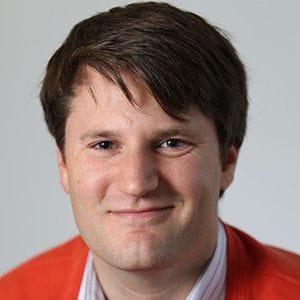
Prof. De Bo was born in Brussels, Belgium. He graduated from the University of Louvain, Belgium (M.Sc. 2004, and Ph.D. 2009 with Prof. István Markó), where he also held his first postdoctoral appointment in the group of Profs J.F. Gohy and C.A. Fustin. He then moved to the UK to join the group of Prof. David A. Leigh (2011-2015), first in Edinburgh then in Manchester. He started his independent career at the University of Manchester under the impulse of a Royal Society University Research Fellowship (2016-2023). He was promoted to Senior Lecturer in 2021 and Professor in 2022. His work aims at controlling the reactivity of molecules under tension for application in synthetic chemistry, materials, and biology.
What does this award mean to you?
It’s a great honour to receive this award. It is a recognition of the dedication and creativity displayed by my team over the past nine years, and it inspires us to continue exploring new frontiers in the field.
How would you describe your research to someone outside your field?
In short, we stretch (macro)molecules to investigate how they break or respond under tension. More specifically, we design and study novel mechanophores—force-sensitive molecules—to gain deeper insights into molecular reactivity under mechanical stress. Our ultimate goal is to integrate these mechanophores into molecular devices, enabling precise, force-triggered responses, such as the controlled release of functional molecules, for applications in materials science, chemical synthesis, and biology.
What inspired you to pursue your area of research?
Back when I was a postdoc, I was preparing a literature review for a group meeting presentation when I came across a paper from Jeff Moore and his team describing the force-promoted ring-opening of benzocyclobutene units in violation of the Woodward-Hoffmann rules. I’d never imagined that force could be used to promote a chemical reaction, let alone pull it towards a forbidden reaction pathway. This discovery blew my mind and drew me into the field of polymer mechanochemistry. It later inspired me to combine mechanical force and mechanical bonds to promote unique mechanochemical transformations—an idea that shaped my first research proposal and remains central to my group’s work today.
What do you think is the biggest challenge currently in your area of research?
Polymer mechanochemistry is a relatively young field. Since its (re)emergence in the early 2000s, it has evolved rapidly, enhancing our understanding of chemical reactivity under mechanical stress and enabling the development of innovative mechanophores for applications such as mechanochromism, force-activated catalysis, and force-controlled molecular release. However, most existing mechanophores are built on a limited set of core structures. To refine reactivity models and expand potential applications, there is now a growing need to explore new molecular architectures. This should unlock the full potential of these molecules beyond the traditional remit of polymer mechanochemistry.
What would your advice be to someone just starting out in the field?
Be bold—don’t hesitate to tackle ambitious projects and innovative ideas. Be patient—great research takes time. But above all, choose work that excites you!
Prof. Julia Ann Kalow
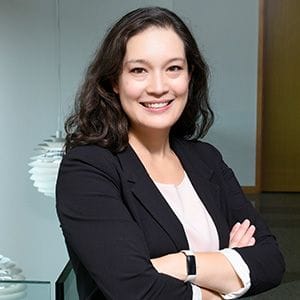
Prof. Kalow grew up in Newton, Massachusetts, and obtained her B.A. at Columbia University in 2008, where she studied chemistry and creative writing. She pursued graduate studies at Princeton University under the supervision of Prof. Abigail Doyle. After completing her Ph.D. in 2013, she was a postdoctoral fellow at MIT with Prof. Timothy Swager. She started her independent career at Northwestern’s Department of Chemistry in July 2016 and was promoted to Associate Professor in 2023.
What does this award mean to you?
This award is a testament to the creativity and persistence of the students and postdocs in my group. I'm honored to be recognized by the journal where I first published as a polymer chemist (ACS Macro Letters), during my postdoctoral studies.
How would you describe your research to someone outside your field?
My group controls the synthesis and properties of polymeric materials using the lens of reactivity. This control often, though not always, involves using light as an external stimulus with spatiotemporal control. We design and synthesize molecules that allow us to tune the macroscopic properties of polymer networks, like stiffness and ability to flow. We're also interested in discovering reactions to make polymers that take advantage of the polymer's inherent properties.
What inspired you to pursue your area of research?
I was trained in small-molecule methodology and mechanistic analysis. I love thinking about how reactions work, but in that world, the outcomes weren't very tangible: peaks on a chromatogram. What I love about polymer science is that you can see and feel the changes in your material in the form of stretchiness, stickiness, color, etc., which is very satisfying. I also appreciate that the polymer community is so welcoming to researchers who were trained in other fields.
What do you think is the biggest challenge currently in your area of research?
This is not an original answer, but polymer sustainability continues to be a multifaceted, complex challenge.
What would your advice be to someone just starting out in the field?
Read the literature (especially ACS Macro Letters, Biomacromolecules, and Macromolecules!). Develop your own opinions; don't rely on impact factor. And, when the time is right, volunteer to review!
Learn About Last Year's Winners

2024 ACS Macro Letters / Biomacromolecules / Macromolecules Young Investigator Award Winners
Get to know the 2024 winners and browse some of their recently published research in ACS journals.
