
To provide additional context about our newest OA publishing route, ACS Publications recently held a webinar to hear and respond to your questions. We invite you to watch the full webinar and browse key questions surrounding this new pathway to OA.

Update: In the original blog post published on November 17, 2023, we mentioned that the Article Development Charge (ADC) was payable before peer review. As of December 1, 2024, this has been changed and the ADC is now due upon acceptance but before publication. This article has been updated accordingly.
In September, ACS Publications announced a new option to support researchers seeking to publish open access (OA) in hybrid ACS journals. Together with gold OA, the new zero-embargo green OA route means authors now have two options to immediately post their accepted manuscript in an open repository—where anyone from any part of the globe can freely distribute, adapt and build upon the manuscript.
Authors who choose this new route pay an article development charge (ADC) to cover the costs incurred by ACS Publications for the publishing service we provide from time of submission through to the journal editors’ final decision.
Since our announcement, there has been good interest in the initiative, and we've received a range of comments and questions related to this option. We really appreciate the positive engagement here and think it would be helpful to respond to the questions received.
To facilitate this, on November 14, James Milne, Ph.D. (President, ACS Publications) and Sarah Tegen, Ph.D. (Senior Vice President and Chief Publishing Officer, ACS Publications), held a webinar to provide additional context about the introduction of this new route.
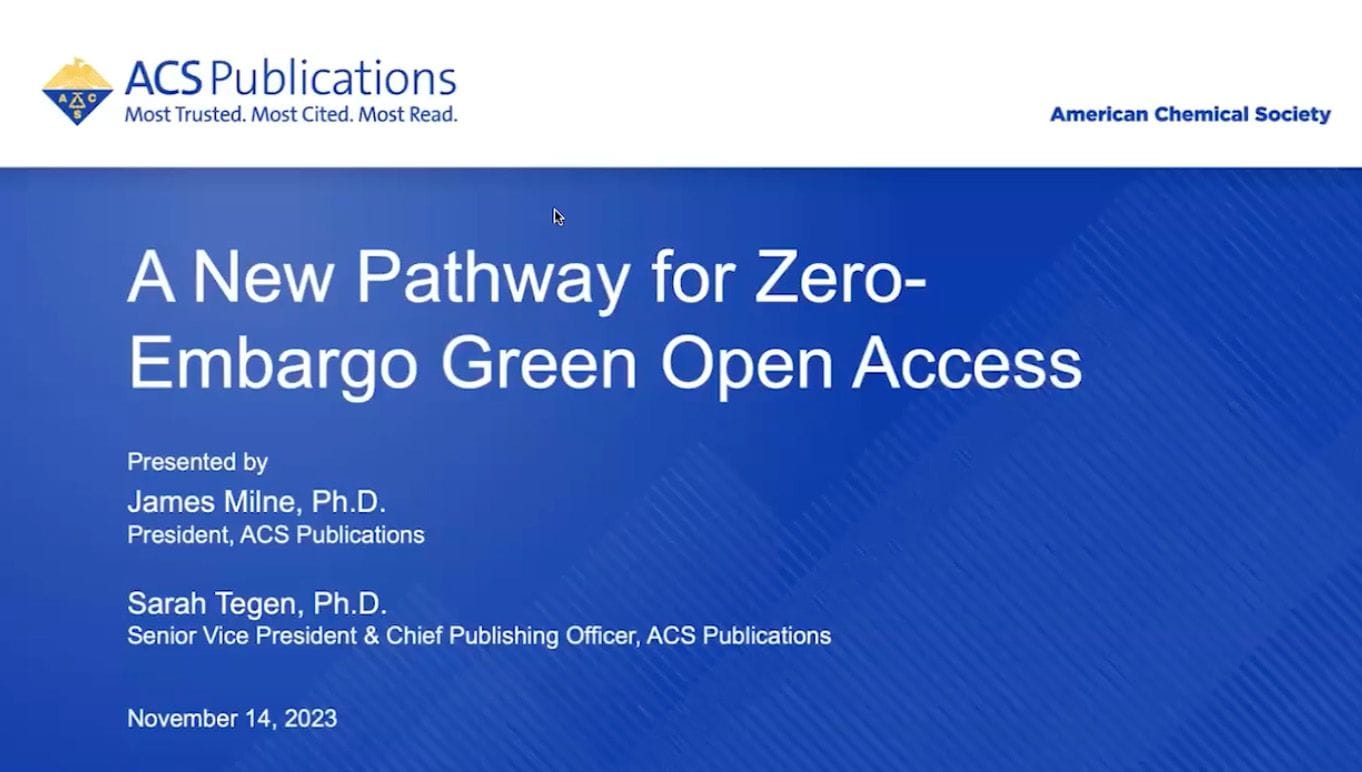
You can watch the full webinar above (approx. 35 minutes). Some of the key questions we answered include:
ACS Publications provides a broad range of options for researchers to publish in our journal portfolio. This new option is a way for ACS Publications to support the growing interest we’ve heard from authors about zero-embargo green OA publishing. We wanted to think creatively about how we can support authors while covering the costs of the services provided up to the final editorial decision. This is to sustain ACS Publications’ activities essential to delivering the highly trusted journals authors and the broader scientific community rely upon.
View the 6:00 mark in the webinar to hear Jim and Sarah address this question.
For the vast majority of submissions (over 99%) this charge will not be relevant and will not apply.
The charge only applies if an author seeks to publish zero-embargo green OA and is not planning to make their article gold OA. It does not apply to:
- Authors covered by a read and publish agreement (currently 16% of published articles);
- Those with funding for gold OA (12% of published articles);
- The majority of authors who are not seeking to publish open access (72%), for whom the 12-month embargo green OA option remains freely available.
View the 16:30 mark in the webinar to hear Jim and Sarah address this question.
The ADC covers the multiple publishing services ACS Publications undertakes through to the editors’ decision and is only applicable after initial checks and editor review. It is entirely optional, and only applies to less than 1% of submissions. ACS journals do not charge submission fees.
Authors always have a no-cost option to have their manuscripts go through the full range of publishing services that ACS providesand freely post their accepted manuscript with a 12-month embargo.
View the 19:04 mark in the webinar to hear Jim and Sarah address this question.
Choosing the zero-embargo green OA route has no impact on author rights.
The ADC is a payment to simply cover the valued publishing services provided, in the lead up to the journal editor making a final decision on the submission. Paying for services sought and received is a widely accepted and practiced concept.
By publishing zero-embargo green OA in an open repository, authors can enable anyone from any part of the globe to freely distribute, remix, adapt and build upon the manuscript, including for commercial use.
View the 17:31 mark in the webinar to hear Jim and Sarah address this question.
When a researcher chooses to post their original manuscript to a preprint server (e.g., ChemRxiv), the version available is entirely the author’s own work. It has not had any of the various integrity checks performed by publishers, nor has it been peer reviewed (noting almost all manuscripts evolve and are developed during this process).
The editor-accepted manuscript, resulting from the ACS-supported processes, is a more advanced and verified version of the article compared to an original manuscript placed in a pre-print server. The version of record hosted on the publisher’s site remains the ‘gold standard’ as favored by most researchers.
ACS Publications is determined to continue providing equitable options for authors and readers around the globe. Researchers from all countries that currently receive special country pricing for APCs will also have waivers and discounts automatically applied for ADCs if they choose to pursue the zero-embargo green OA option.
Additionally, there remain multiple free options for authors to disseminate their research through ACS journals.
View the 23:19 mark in the webinar to hear Jim and Sarah address this question.
The subscription rates for ACS journals are calculated based on the usage of published articles on our ACS platform (pubs.acs.org). For this calculation, we specifically exclude the usage of OA articles on the platform (i.e., those published either gold or diamond OA).
When an author chooses to publish zero-embargo green OA and posts the final editor accepted manuscript in repositories, the usage of the article on the ACS Publications site will be impacted. This will lower the usage count considered when determining the subscription rate.
The ADC covers the services provided leading up to editorial decision and provides a sustainable solution to support the costs that would otherwise be paid through subscriptions.
View the 21:01 mark in the webinar to hear Jim and Sarah address this question.
The ADC supports multiple activities beyond just scholarly peer review, although that comprises a sizable effort. Prior to peer review all submissions undergo initial vetting, including numerous data checks, and are giving an initial assessment usually by two journal editors. Only following this step does the peer review process get initiated. The charge also covers investments in developing and sustaining the platforms, systems, and support services necessary to facilitate high-quality scholarly peer review.
View the 25:55 mark in the webinar to hear Jim and Sarah address this question.
If a manuscript is not accepted for publication, no ADC will be charged. If an author has opted into zero-embargo green OA and the manuscript has been accepted for publication, it will be published once the ADC is paid.
Our goal at ACS Publications is to support every author who wants to publish with us, and the zero-embargo green OA option is an additional, innovative way to help ensure this can be achieved for more authors.