
ACS modernized heavy metal testing by replacing subjective sulfide limit tests with precise ICP methods, aligning reagent standards with modern analytical expectations and clarifying how ACS and regulatory standards complement one another.

In an earlier post, we explored the different roles that ACS reagent standards and regulatory frameworks play. Here, we examine how ACS Reagent Chemicals standards complement pharmacopoeial standards such as USP, through one analytical example: the modernization of heavy metal testing.
From Classical Tests to Instrumental Analysis
Historically, many reagent specifications relied on sulfide precipitation limit tests to assess “heavy metals” as a class. While widely used for decades, these tests are well known for their analytical limitations. Results are often subjective, detection capability is limited, and they provide little—if any—information about which elements are actually present.
As expectations for impurity control became more element-specific, these legacy methods became increasingly difficult to justify. They no longer reflected best analytical practice, nor could they support the level of accuracy and specificity required for modern applications.
To address this gap, ACS Reagent Chemicals modernized many reagent monographs by replacing sulfide-based tests with ICP-OES for appropriate reagent chemicals and ICP-MS where lower detection limits or matrix complexity require it. These methods provide quantitative, element-specific data with well-defined performance characteristics, aligning reagent specifications with contemporary trace-element analysis.
Alignment Through Scientific Intent, Not Duplication
This modernization was not a matter of simply copying pharmacopeial chapters or adopting regulatory language verbatim. Instead, the ACS Committee on Analytical Reagents took a fit-for-purpose approach, evaluating impurity risks in the context of routine laboratory risk.
Method selection reflects a deliberate balance:
- Preserve analytical integrity through scientifically sound, selective, and reliable techniques
- Maintain practicality and accessibility to ensure methods can be broadly implemented
- Avoid unnecessary burden, particularly where the intended use does not require ultratrace detection or full pharmaceutical-method validation
Such balance is reflected in how methods are applied across contexts. Regulatory elemental impurity procedures for drug products are designed to demonstrate control against toxicologically based limits using validated, product-appropriate methods. In contrast, reagent testing used to support research, routine quality control, and general laboratory use must balance robustness, efficiency, and throughput with accuracy.
By focusing on scientific intent, ACS standards complement regulatory frameworks while remaining practical for diverse laboratory environments.
Conclusion
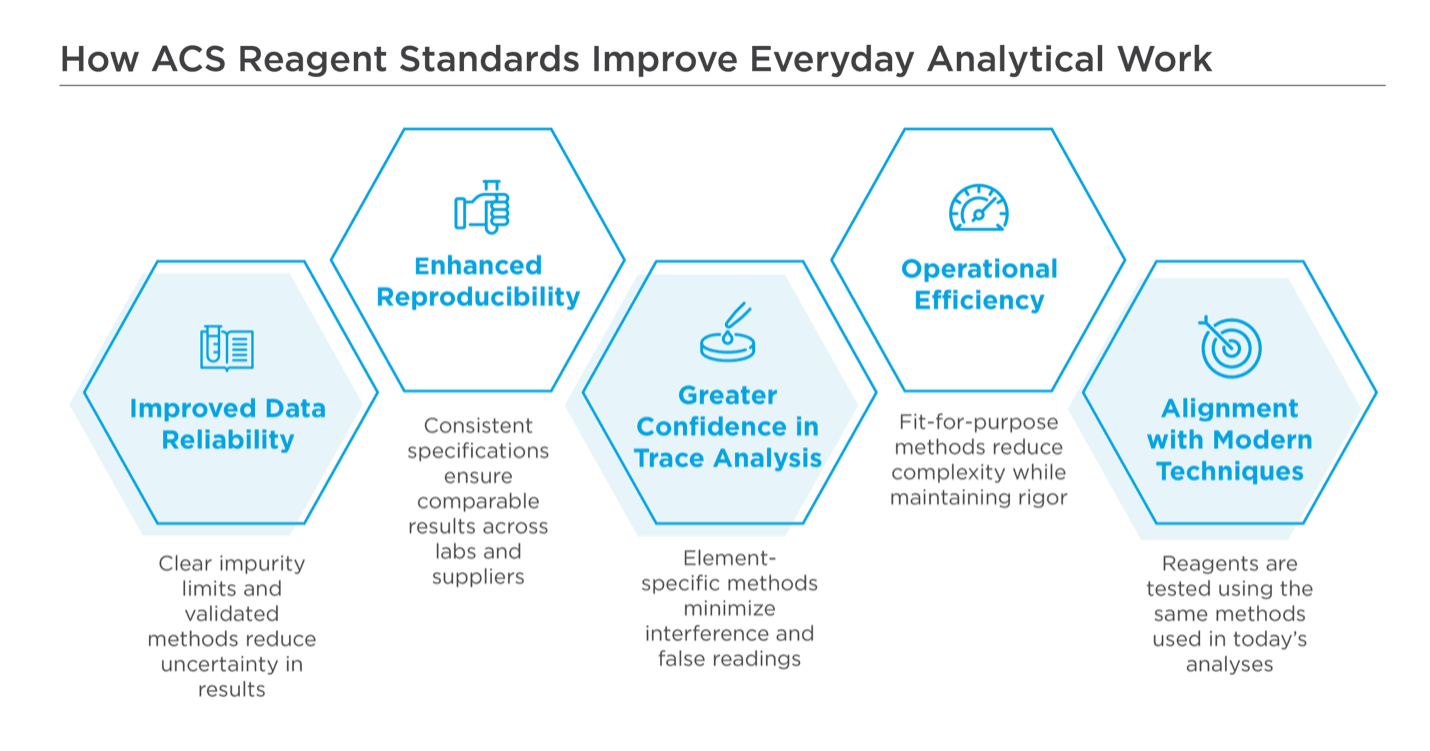
The modernization of heavy metals testing illustrates how ACS Reagent Chemicals occupies a distinct and valuable role alongside regulatory frameworks. The standards translate advances in analytical science into practical reagent specifications.
The result is a system that helps make reagents more consistent, better characterized, and fit for modern laboratory use. For analytical chemists, this means fewer ambiguous impurity results, stronger comparability across laboratories and suppliers, and more defensible data when reagents become part of research, quality-control, or regulated workflows.
Contributions to this article were made by Abraham S. Finny, Celia Williams, Joseph Crockett, James Grinias, Kelly Peshman, Robert Thomas, Tom Tyner, and Tom Xiao.