Read exclusive interviews with the winners, Emily Mevers, Christopher Rice, and Karin Steffen, and learn about their winning papers in the Journal of Natural Products.
The Journal of Natural Products, in partnership with the American Society of Pharmacognosy (ASP), is honored to announce the 2026 winners of the Arthur E. Schwarting (Emily Mevers) and Jack L. Beal Awards (Christopher A. Rice), as well as the inaugural winner of the A. Douglas Kinghorn Award (Karin Steffen).
The Arthur E. Schwarting and Jack L. Beal Awards recognize the best papers published each year in the Journal of Natural Products. The Schwarting Award is open to all papers published in the journal within a given year, while the Beal Award is awarded to early career investigators. This initiative was launched in 2001 by the Foundation Board of ASP to honor two distinguished former editors of the journal and has continued ever since.
This year the journal and society have added a new annual award honoring A. Douglas Kinghorn, BS Pharm, PhD, DSc, FRPharmS, Distinguished University Professor, Jack L. Beal Chair of the Division of Medicinal Chemistry and Pharmacognosy at the College of Pharmacy, and a global leader in natural products research. The A. Douglas Kinghorn Award for Best Perspective or Review recognizes scholarship that defines and anticipates emerging scientific trends. The award underscores Dr. Kinghorn’s enduring legacy as a scientist, mentor and editor whose career has helped define the modern natural products community.
Meet the Winners:
Emily Mevers
Christopher A. Rice
Karin Steffen
Meet Emily Mevers, Winner of the Arthur E. Schwarting Award

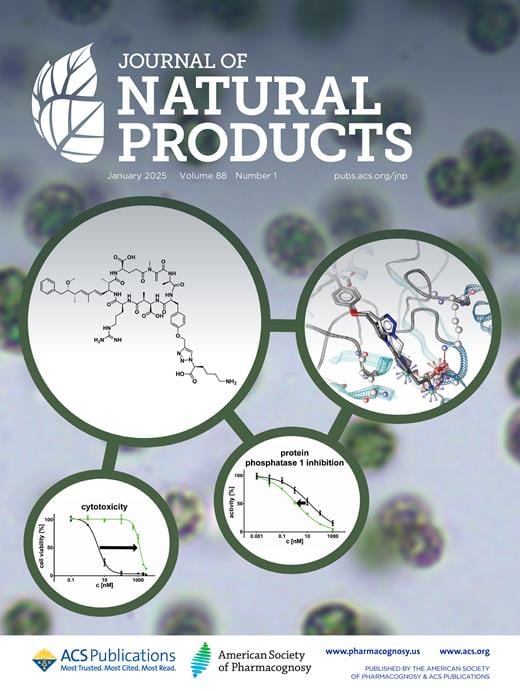
Read the winning paper
Neuromodulating Alkaloids from Millipede Defensive Secretions
Carla Menegatti, Jared S. Wood, Paige Banks, Kenneth Knott, Jonathan S. Briganti, Anthony J. Briganti, Samuel V. G. McNally, Paul E. Marek, Anne M. Brown, Tappey H. Jones, R. Thomas Williamson, Emily Mevers
J. Nat. Prod. 24 January 2025; 88 (1): 110–118
DOI: 10.1021/acs.jnatprod.4c01162
J. Nat. Prod. 24 January 2025; 88 (1): 110–118
DOI: 10.1021/acs.jnatprod.4c01162
Can you give a short overview of the research you are currently undertaking?
I am a chemist who loves elucidating the structures of naturally occurring small molecules and deciphering their ecological roles to inform potential biomedical applications. My independent research group is studying the natural products that 1) defend animals from predation (primarily arthropod chemical defenses), 2) mediate symbiotic interactions (microbial symbionts of moon snail egg masses), and 3) enable microbes to respire on metal oxides for biosensing applications. Each of these research areas has important applications, including developing new drug candidates for the treatment of neurological diseases, immunotherapies, and antimicrobial agents, as well as improving existing biosensing applications.
More specifically, our current work involving the millipedes is focused on two fronts:
- Identifying the biosynthetic genes in the millipede that is responsible for the assembly of the alkaloids. This will allow us to investigate the evolution of this pathway in the animal and to potentially utilize the genes in a chemoenzymatic synthesis.
- We are chemically analyzing unstudied millipedes to understand the true chemical diversity of the alkaloids within this understudied system.
How was the process of collaborating with your co-authors on this award-winning paper?
This project was only possible through interdisciplinary collaborations. First, Tappey Jones deserves all the credit for getting me interested in millipedes, as he provided us with the initial millipedes for our studies. Samuel McNally and Paul Marek are both entomologists who helped us acquire more specimens and/or gave my group a crash course in millipede biology. Finally, both Anne Brown’s and Thomas Williamson’s groups provided critical analyses that my team lacked. First, Anne's team performed all molecular docking with Sigma-1, which led us to propose that these compounds act as antagonists. Thomas' team is experts in complex NMR analyses, and his contribution allowed us to confidently assign the absolute stereoconfiguration of the compounds. A first for this class of compounds and has aided our subsequent med chem studies.
Why did you choose to publish with the Journal of Natural Products, and why do you like publishing with the journal?
Full honesty, we struggled to get it in at other places due to the niche study system. However, I LOVE the Journal of Natural Products! The review process is fair, with great respect for all parties, and papers published in J. Nat. Prod. gain considerable visibility among fellow natural product chemists and in related fields. After this publication came out, many of my colleagues across the US emailed me to congratulate us. That has only ever happened when I publish in J. Nat. Prod.
Meet Christopher A. Rice, Winner of the Jack L. Beal Award

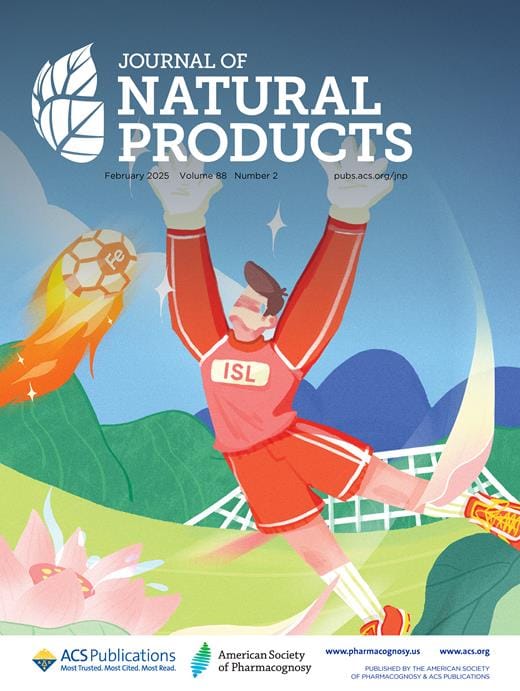
Read the winning paper
Cyclic Peptide Natural Product Inspired Inhibitors of the Free-Living Amoeba Balamuthia mandrillaris
Chenyang Lu, Samantha Nelson, Gabriela Coy, Chris Neumann, Elizabeth I. Parkinson, Christopher A. Rice
J. Nat. Prod. 28 February 2025; 88 (2): 274–281
DOI: 10.1021/acs.jnatprod.4c00834
J. Nat. Prod. 28 February 2025; 88 (2): 274–281
DOI: 10.1021/acs.jnatprod.4c00834
Can you give a short overview of the research you are currently undertaking?
The Rice Research Group focuses on preclinical drug discovery and development, drug repurposing, diagnostic tool development, and host-pathogen interactions specifically for pathogenic free-living amoebae. This includes some of the most neglected and almost always fatal diseases caused by Balamuthia mandrillaris, Acanthamoeba species, and Naegleria fowleri; more commonly referred to as the "brain-eating amoeba".
We perform a lot of phenotypic high-throughput screening with these pathogens to discover hit candidates and new chemical entities which our medicinal chemistry collaborators generate structural analogs to drive our hit-to-lead drug development program. Our lead-like candidates we can take all the way through to amoebic brain or eye diseased models as a proof-of-concept curative in vivo model suggestive of clinical translation.
How was the process of collaborating with your co-authors on this award-winning paper?
Dr. Elizabeth (Betsy) Parkinson is a great collaborator; she was one of my first from Purdue Chemistry when I moved here to Purdue University in 2022. We joined forces together having both attended the Purdue Institute of Inflammation, Immunology and Infectious Disease (PI4D) annual symposium that December. It wasn't until Spring of 2023 when we screened Betsy's Synthetic Natural Product Inspired Cyclic Peptides "SNaPP" library derived from transcriptionally inactive (cryptic) biosynthetic gene clusters found in bacterial species. We identified novel hit cyclic peptides against all amoebae, but our better hits were against Balamuthia mandrillaris, thus coining these as Balamuthia Inhibiting Cyclic Peptides (BICyPs). Excitingly, these peptides represent novel chemical entities against amoeba and demonstrate potency comparable to nitroxoline, one of the current standard-of-care agents used for the treatment of Balamuthia brain infections. Furthermore, our BICyPs exhibit superior activity compared with all other currently recommended standard-of-care therapeutics, highlighting their promise as next-generation treatment candidates for Balamuthia amoebic encephalitis (BAE).
Why did you choose to publish with the Journal of Natural Products, and why do you like publishing with the journal?
Since 2018 and publishing my first paper in the Journal of Natural Products with other collaborators in the natural product community, I have come to appreciate its unique position in providing a dedicated platform for showcasing and highlighting innovative and multidisciplinary NP research that might otherwise be overlooked in broader chemistry journals. With JNP’s longstanding reputation for publishing rigorous, high-quality science makes it an exceptional platform for disseminating our unique and very narrow-focused work. I greatly value the insightful guidance and feedback provided by the reviewers, associate editors, and editor-in-chief whose thoughtful and personalized critiques strengthened the quality, clarity, and impact of our award-winning manuscript.
Thank you all and thanks to the serving members of the Schwarting, Beal & Kinghorn awards committee for selecting our paper; I/we greatly appreciate and it's an honour to receive this prestigious Jack L. Beal award.
Meet Karin Steffen, Winner of the A. Douglas Kinghorn Award for Best Perspective or Review

Read the winning paper
Machine-Readable Structural Information Is Essential for Natural Products Research
Karin Steffen, Nicholas H. Oberlies, Antonis Rokas
J. Nat. Prod. 28 November 2025; 88 (11): 2815–2821
DOI: 10.1021/acs.jnatprod.5c00836
J. Nat. Prod. 28 November 2025; 88 (11): 2815–2821
DOI: 10.1021/acs.jnatprod.5c00836
Can you give a short overview of your award-winning Perspective?
My perspective was borne out of the curiosity to connect natural product chemistry to biology and the difficult bridging these realms that are fundamentally connected. In “biology” (genomics to be more precise), a lot of data is readily available, cataloged, searchable and freely accessible in a handful of global repositories (e.g. ENA or GenBank for as entry points for much of sequencing data). Yet in natural product chemistry, all the tedious and diligent work isolating, elucidating and describing compounds gets disconnected from the organisms and the structural information is often not readily extractable and must be manually gathered. If you had a set of paired data, species of origin and known described compounds, that would enable a plethora of insightful analyses: are there taxa (organismal groups) that are understudied? Are there sister species to a rare organisms producing a compound of interest that might be studied instead? Are there lineages that are more prolific in their natural product portfolio? And why? The list goes on. I hope that when keeping the information connection, i.e. organism and its compound SMILES/InChI, such questions can be readily answered in the future.
How was the process of collaborating with your co-authors on this paper?
I loved it! Everybody was immediately on board with the idea and supported and encouraged me tremendously. Writing this perspective was a lot of fun and felt meaningful as it started as a genuine question in an email to my co-authorsasking why it was so hard to find and access chemoinformatic compound collections, data bases or any structured information on natural products. I have a biology background where open data bases are the standard, so this “wall of data access” hit me by surprise. At the core, the perspective tries to lift the countess efforts by natural product chemists all over the world by making their work findable, accessible and re-usable. And I do hope everybody benefits by adopting practices suggested in the perspective. Writing a perspective with that in mind is a very gratifying experience.
Why did you choose to publish with the Journal of Natural Products, and why do you like publishing with the journal?
In my years as grad student and postdoc, I have had many positive experiences with the journal. Particularly to the publishing process at JNP, I would say, the engagement of reviewers and the editors is unique in all my experiences. The desire for making each paper its bester version and delivering quality to the readers is very obvious.