
This annual award honors the authors of a research article that has made notable impact within materials chemistry and also recognizes the team nature of the winning research. Learn more about the 2026 winners.

Chemistry of Materials and the ACS Division of Polymeric Materials: Science and Engineering (PMSE) are excited to announce “Latently Curable Ultra-High Molecular Weight Polymers with Dimensional Stability” as the winner of the 2026 Chemistry of Materials Lectureship and Best Paper Award, which honors the authors of an article published in 2024 or 2025 that has outstanding influence across materials chemistry and recognizing the team nature of research.
This year's winning paper was authored by:
- Joshua D. Marquez, University of Florida, United States
- Gunzaya Otgonjargal, University of Florida, United States
- Kevin A. Stewart, University of Florida, United States
- A. M. Mahmudul Hasan, University of Florida, United States
- Graham C. Gilchrist, University of Florida, United States
- Brent S. Sumerlin*, University of Florida, United States
- Austin M. Evans*, University of Florida, United States
*corresponding authors
Prof. Sara E. Skrabalak, Editor-in-Chief of Chemistry of Materials, noted that “This outstanding paper exemplifies both the creative materials chemistry and collaborative spirit that Chemistry of Materials seeks to showcase. By bringing together complementary expertise in polymer synthesis, polymer physics, and thermomechanical characterization, Evans and coworkers harness the unusually slow relaxation dynamics of ultra-high-molecular-weight polymers to create single-component, latently curable materials with exceptional stability. The work demonstrates how a team-based approach can connect fundamental molecular insight with practical materials design to address a long-standing challenge in polymer processing.”
Read the winning article:
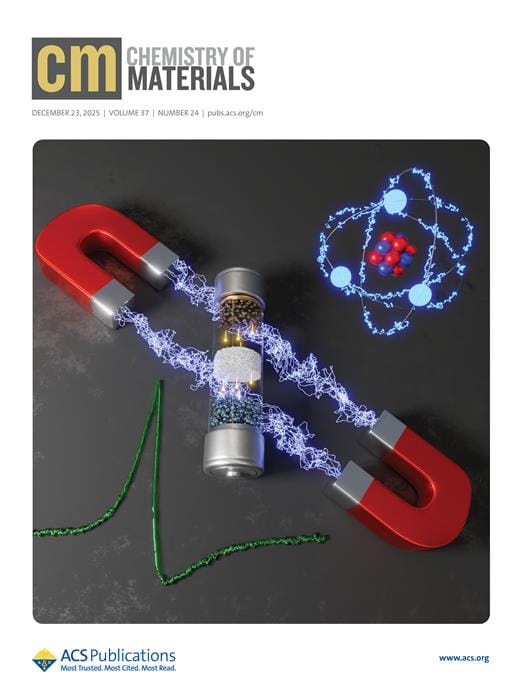
Latently Curable Ultra-High Molecular Weight Polymers with Dimensional Stability
Joshua D. Marquez; Gunzaya Otgonjargal; Kevin A. Stewart; A M Mahmudul Hasan; Graham C. Gilchrist; Brent S. Sumerlin; Austin M. Evans
DOI: 10.1021/acs.chemmater.5c02557
DOI: 10.1021/acs.chemmater.5c02557
Read the Interview with This Year’s Winners
Below, we interview corresponding author Prof. Austin Evans to learn more about the team’s winning research.

How did this team come together to collaborate on this research?
This project started organically from genuine student interaction in the lab. Specifically, Kevin Stewart (now a postdoctoral researcher at the University of Utah), and Josh Marquez (now a research scientist at FloMaterials), postulated that our newly discovered method for reaching ultra-high molecular weights in styrenic materials could be made compatible with a commercially deployed latent crosslinker. This origin is a great reminder that the best ideas always come from collaborative student insights.
What challenges did you overcome on the way to getting the results you reported in your paper?
One of our biggest hurdles was figuring out how to mold the material without prematurely triggering cross-linking. That breakthrough came when Josh had the idea to install alkyl pendants to modify the material's glass transition temperature. He later extended this side-chain engineering strategy to other styrenic systems (Angew. Chem. Int. Ed. 2026, 65, e5251809), thereby allowing us to access a wide range of mechanical characteristics. Co-optimizing materials design and nanoscale chemistry highlights the strength of our team’s approach to this challenge.
What new research are you doing to build on the findings you described in your paper?
Moving forward, I am really excited about investigating other macroscopic processes that can be disentangled (no pun intended) from reptation when polymer backbones are exceptionally long. I expect this direction will lead to ultra-strong materials with remarkable shape retention and transport properties that conventional molecular weight materials simply cannot achieve.
What advice would you give to research teams who aspire to be where you are now?
I truly believe that the best ideas arise organically, so it is crucial to follow your observations wherever an interesting direction leads. I benefit immensely from the ingenuity of my laboratory team, and I often notice that our newest members bring some of the most clever perspectives to the table. I find that being open to new directions, new collaborations, and new ideas is one of the best parts of our profession.
Get e-Alerts
Stay Connected With Chemistry of Materials
Never miss an issue again! Sign up now for email updates on future calls for papers, the latest articles, and other content from Chemistry of Materials.
