
A new study examines how microscale design choices improve the motion and adaptability of magnetic soft robots through enhanced actuator performance.

Magnetic soft actuators have become an essential tool for researchers exploring biomedical devices, soft robotics, and microfluidic systems. Their ability to bend, twist, or contract without physical contact makes them useful in environments where rigid components fall short. But most existing magnetic actuators still face a persistent design limitation: striking the perfect balance between strength and flexibility. Strengthening the magnetic response usually makes them stiffer, while increasing flexibility often weakens their magnetic performance.
A new study in ACS Applied Materials & Interfaces describes a novel way around this trade-off. Researchers at Xi'an Jiaotong University, China, The team developed a magnetic soft actuator using thin films from PDMS (a soft, biocompatible silicone) loaded with tiny NdFeB magnetic particles. Instead of mixing the particles uniformly—a common design goal in earlier work—this method encourages the particles to gather in tiny pockets while the surrounding PDMS stays soft. This subtle shift in design philosophy leads to a material that is both highly flexible and capable of generating strong magnetic forces.
This recent Headline Science captures the actuator in motion:
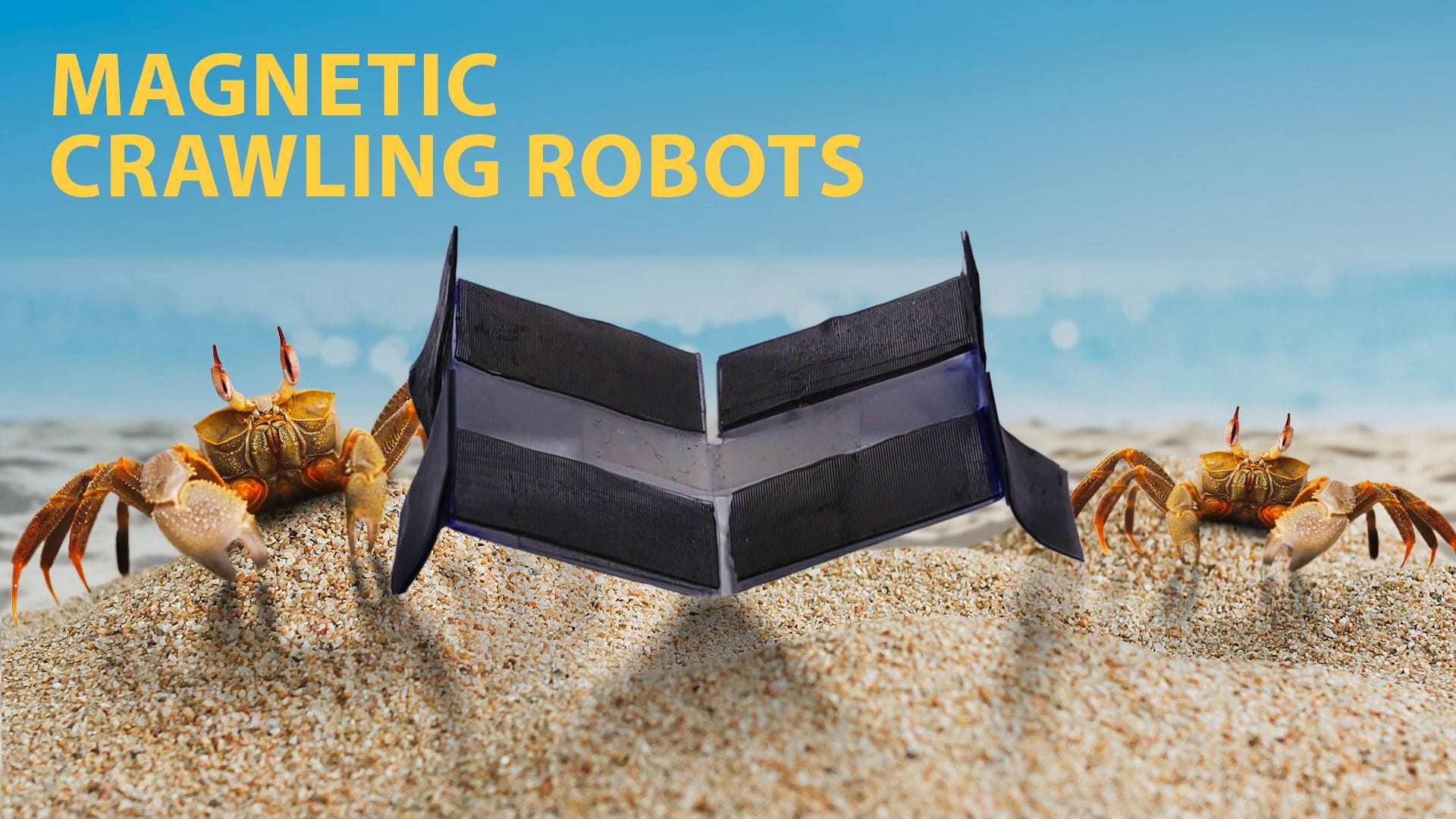
In tests, the microstructured films bent more easily and reacted more strongly to nearby magnets compared to traditional mixed films. Further analysis revealed that the particle‑rich segments act as the main load-bearing elements, like muscles, while the PDMS between them behaves like flexible joints. This division of labor lets the material turn magnetic input into large, controlled bends.
When shaped into different forms, the films produced smooth caterpillar‑like ripples, flapped like butterfly wings, and opened and closed like a soft robotic hand. Built into small robots, the material enabled inchworm‑style crawling, underwater movement through a narrow tube, and travel across a range of surfaces. A separate quadruped design showed that the films could also coordinate leg‑like motions to move steadily forward.
Because the fabrication steps are straightforward and easy to repeat, this approach could one day support soft robotic tools, microfluidic devices, and biomedical systems where gentle, responsive movement is useful. The authors note that pairing this microstructured strategy with even softer elastomers could lead to larger deformations—a direction for future work. For now, their results show that carefully organizing magnetic particles at the microscale can produce films that are both soft and strong, opening new possibilities for magnetic actuation.
Watch more Headline Science on YouTube!
The video above is brought to you by the ACS Science Communications team. To watch more exciting videos and shorts covering some of the latest research in ACS journals, visit the Headline Science page on YouTube.
Video credits:
Written and produced by Anne Hylden
Edited and animated by Janali Thompson
Hosted by Anne Hylden
Series produced by Vangie Koonce, Anne Hylden, Andrew Sobey, and Jefferson Beck with assistance from Elaine Seward and Kerri Jansen
Executive produced by Matthew Radcliff
Explore related content from ACS Publications
Blog Posts:
Magnetic Paper Robots: Unfolding Potential for Intelligent Applications
Journal Articles:
Flexible PDMS-NdFeB Composite Membrane for Haptic Force Perception
Xiaoyu Zhao, Fei Li, Liuxia Ruan, Jiahong Wen, Yongjun Zhang, Renxian Gao, Fengyi Zhang, Kun Zhang, Yaxin Wang*, and Wenzhen Yang*
DOI: 10.1021/acsaelm.5c00070
Moisture-Sensitive Fe2O3 Nanoparticle-Based Magnetic Soft Actuators
Santhosh Narendhiran, Shibu Meher, Soumen Midya, Subhendu Mishra, Soumya Priyanshi Prusti, Manoj Balachandran, Abhishek Kumar Singh*, and Partha Kumbhakar*
DOI: 10.1021/acsanm.4c04627
Magnetic Bistable Dome Actuators for Soft Robotics with High Volume Capacity and Motion Stability
Chayut Buranabunwong, Xingxiang Li, Shutong Nong, Boxi Sun, Yuxuan Sun*, Shiwu Zhang*, and Mujun Li*
DOI: 10.1021/acsami.4c18242
From Molecules to Machines: A Multiscale Roadmap to Intelligent, Multifunctional Soft Robotics
Yang Li, Sanjay Schreiber, Haochen Yang, Muchun Liu, Joshua M. Little, Wanqing Cao, Yaguang Luo, Yinyin Bao*, Chih-Jen Shih*, Hedan Bai*, and Po-Yen Chen*
DOI: 10.1021/acs.chemrev.4c00972
An Integrated Strategy for Soft Robotics: Wireless Sensing Enabled by Laser-Sintered Silver
Jiale Lin, Guifang Shao, Dezhi Wu, and Qibin Zhuang*
DOI: 10.1021/acsami.5c06561
A Laser Thermal-Curing Printing: Integrating Fabrication, Reparability, Reconfigurability, and Reprogrammability for Magnetic Soft Robots
Yilin Zhao, Longju Yi, Yunfan Li, Ziran Zeng, Zhe Liu, Tian-Ling Ren*, Yong Ruan*, and Feng Liu*
DOI: 10.1021/acsami.4c22950
