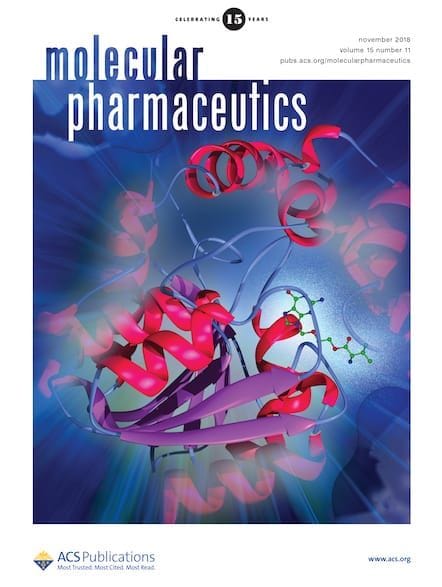
This award recognizes three early-career authors, highlighting their exceptional research published in the journal and the profound impact it has had on the field of molecular pharmaceutics. Learn about the 2026 winners and their research.

We are pleased to announce the winners of the 2026 Molecular Pharmaceutics Early Career Best Paper Award. The winners were selected based on the quality and potential impact of their research recently published in Molecular Pharmaceutics. Our winners are early career scientists (<10 years post Ph.D.) from one of three major geographical regions (the Americas, Europe/Middle East/Africa (EMEA), and Asia Pacific).
We received a significant number of nominations. The selection committee was impressed by the exceptionally high quality of the candidates. We thank everyone who submitted nominations for the 2026 Molecular Pharmaceutics Early Career Best Paper Award.
We are excited to announce the 2026 winners from each region:
- Michaela Cohrs (EMEA)
- Nicholas Fletcher (Asia Pacific)
- Mingyue Li (Americas)
As part of the award, the winners will present their research as part of ACS Publications' Winners Week 2026 webinar series in June 2026 (details to come).
Read on to learn more about each recipient and read their winning papers.
Michaela Cohrs, Belgium
Winning Article: Intrinsic Differential Scanning Fluorimetry for Protein Stability Assessment in Microwell Plates
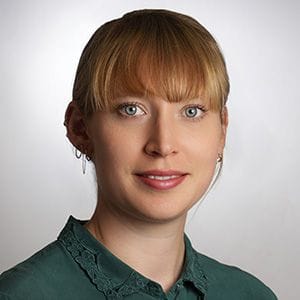
Michaela Cohrs is a Ph.D. student exploring the stability and aggregation of monoclonal antibodies from development to in-hospital handling under the supervision of Prof. Hristo Svilenov (TUM) and Prof. Stefaan De Smedt (UGent). She completed her pharmacy studies at Martin Luther University Halle-Wittenberg, supported by the Deutschland Stipendium, and conducted her diploma thesis at the University of Vienna. She also gained industry experience at Bayer AG, focusing on parenteral formulation development of biologics, including subvisible particle analysis, and freeze-drying processes.
Her research, combining expertise in antibody developability, stability, and advanced analytical techniques, is funded by an FWO PhD Fellowship. Beyond her research, Michaela contributes to the scientific exchange within the working community “Biopharmaceutical Product Attributes and Biological Consequences” under AAPS as a Secretary.
What does this award mean to you?
It is a true honor and an important milestone in my scientific career to receive the Early Career Best Paper Award from Molecular Pharmaceutics. This recognition highlights the efforts to rigorously test and expand a platform technology that is widely used in pharmaceutical development. The award encourages me to consider how established tools can be improved, and it reminds me that scientific contributions are possible early in one’s career – especially with the right team.
With this in mind, I would like to emphasize that I am receiving the award on behalf of the entire team, to whom I am deeply grateful. I am especially thankful to my supervisor, Prof. Hristo Svilenov, for his invaluable support and guidance.
How did your team come together to collaborate on this research?
The project grew from a collaboration between industry and academia, with our academic team focusing on expanding and critically examining the current use of DSF. By combining expertise in protein development, hardware knowledge, and coding skills across different universities and industry, we were able to push the capabilities of a platform that breaks boundaries in throughput and sample consumption for the analysis of protein stability.
What is next in your research?
My PhD project focuses on the developability of monoclonal antibodies with the goal of enabling safer protein therapeutics in the clinic. Building on our experience with DSF, we are questioning the use of traditional developability assessment for predicting interfacial stability. Our aim is to open new perspectives on mAb characterization by integrating surface tension and surface rheology measurements. To complete the picture, we are also investigating stability risks during mAb handling, such as those that may occur when diluting antibody drugs into infusion bags.
What would your advice be to someone just starting out in the field?
My advice would be to stay curious, persistent, and open to learning from different perspectives. Discussion across disciplines, as well as between industry and academia, is invaluable, and having the right team – who challenge and support you – makes the difference.
Nicholas Fletcher, Australia
Winning Article: Development of a Novel Engineered Antibody Format for PSMA-Targeted Radionuclide Therapy
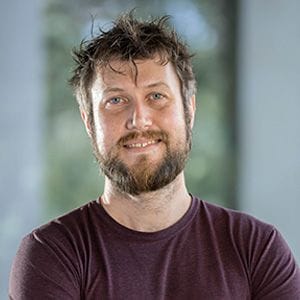
Dr. Nicholas Fletcher is a research-focused academic driving studies in the radiobiology and radiopharmaceutical development space. He is based within the Centre for Advanced Imaging (CAI) at the Australian Institute for Bioengineering and Nanotechnology (AIBN) where he is the Radiobiology Theme Leader.
What does this award mean to you?
This publication reflects more than 5 years of ongoing research and development to produce the reported engineered antibody platform for radiopharmaceutical delivery. It was part of an extensive research program between academics at the University of Queensland with Telix Pharmaceuticals and Abzena.
This recognition of our work is an honour and along with the publication itself signifies a milestone in my scientific career. It recognises the outcomes of a long-standing and impactful collaboration with Telix Pharmaceuticals as well as the significant body of work involved.
How did your team come together to collaborate on this research?
The research was part of my PhD work and a collaboration with my supervisors Associate Professor Natalie Trevaskis and Professor Joe Nicolazzo, who specialize in lymphatic drug delivery and drug delivery to the brain, respectively. I worked closely with then-Trevaskis lab members Dr Gracia and Dr Enyuan Cao, who both have extensive experience with lymphatic drug transport animal models.
What is next in your research?
My own research aligns with the ultimate goals of this research publication to produce efficacious and targeted radiopharmaceuticals. My own work is now particularly focused on radiobiology and understanding the nuanced biological and immunological impacts of targeted radiopharmaceuticals in my role as the Radiobiology Theme Leader at UQ.
What would your advice be to someone just starting out in the field?
Everyone's experience starting in research is unique but I think it was crucial for me to surround myself with smart and supportive research collaborators who were happy to Don’t lose your curiosity and drive, science should still be interesting and fun. Also seek out the collaborators you need to do good science, not just who is available around you. The right experts make all the difference.
Mingyue Li, United States
Winning Article: Molecular Insight into Lipid Nanoparticle Assembly from NMR Spectroscopy and Molecular Dynamics Simulation
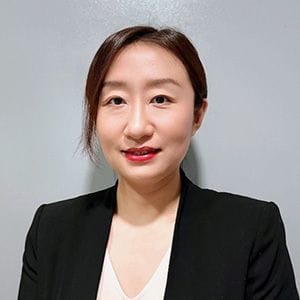
Mingyue Li, Ph.D., is a Principal Scientist in Analytical R&D of Biotherapeutics & Pharmaceutical Sciences at Pfizer, Inc., based in Andover, Massachusetts. Mingyue leads the Technology & Innovation team in ARD, orchestrating innovation in analytical technologies to support preclinical to clinical development of biotherapeutics. Mingyue serves as a subject matter expert on various analytical and biophysical techniques for structure elucidation, attribute understanding, and comparability assessment. She leads the development of nuclear magnetic resonance (NMR)-based techniques for application to multiple areas of biologics development including understanding structure-function relationship, formulation and bioprocess development.
What does this award mean to you?
I’m truly honored to receive this recognition, which reflects a remarkable team effort to advance our understanding of the molecular assembly of lipid nanoparticles (LNPs). This work began as a proof-of-concept during the COVID-19 pandemic, a time when LNPs played a pivotal role in enabling mRNA vaccine delivery. While designing and manufacturing stable, effective, and targeted LNP delivery systems remains a significant challenge, I hope the findings and methodologies presented in this research will contribute to broader applications of LNPs, and lipid-based particles more generally, in drug delivery and ultimately help improve patient outcomes.
How did your team come together to collaborate on this research?
This work was inspired by the growing application of LNPs for oligonucleotide delivery. Yongchao Su and Angela Wagner, with deep expertise in analytical sciences and LNP formulation, conceptualized the project with the goal of structure-guided drug product design. It was truly a collaborative effort, bringing together exceptional scientists from Merck & Co., Inc. and the University of Connecticut to integrate high-resolution analytical tools with molecular dynamics simulations for a deeper understanding of complex molecular systems.
What is next in your research?
My current research focuses on advancing nuclear magnetic resonance (NMR)-based techniques and developing novel biophysical approaches. These methods are being applied across multiple areas of biologics development, including understanding structure-function relationship, formulation and bioprocess development.
What would your advice be to someone just starting out in the field?
My advice to junior scientists is to learn as much as possible from the experts around you-you’ll grow quickly both professionally and personally. Stay flexible in a dynamic environment, take ownership of your work, nurture curiosity, and most importantly, enjoy what you do.
Learn About Last Year's Winners