
Explore interviews with researchers and innovation leaders in India, complemented by a selection of recent ACS journal articles highlighting emerging scientific advances.

India celebrates National Technology Day each year on May 11, commemorating key milestones in the nation’s technological journey and celebrating the role of science, engineering, and innovation in national development. The day serves as an opportunity to reflect on how indigenous technologies, born in laboratories, research institutions, and startups, have contributed to strategic self‑reliance, economic growth, and societal impact. Over the years, National Technology Day has evolved into a platform for recognizing the people and ideas driving technology‑led progress across sectors.
As India continues to strengthen its position as a global hub for deep‑tech and translational innovation, the role of researchers, technologists, and innovation leaders has never been more critical. In this feature, we highlight voices from across academia, startups, and innovation foundations who are working at the intersection of fundamental science and real‑world application. Additionally, we present a curated collection of research articles published in ACS journals that spotlight recent advances by Indian researchers, reflecting the breadth of scientific inquiry fueling emerging technologies.
In this Article:
Hear Voices from Scientific Leaders in India
- Dr. Rajappa Tadepalli
- Prof. Ambarish Ghosh
- Dr. Radhika Trikha
Explore Research Highlights Published in ACS Journals
Hear Voices from Scientific Leaders in India
Through this curated set of interviews, contributors share insights on translating research into impact, fostering interdisciplinary collaboration, and building technologies that are globally relevant yet locally grounded. Together, these perspectives offer a snapshot of India’s evolving technology landscape and the scientific leadership shaping its future.
Dr. Rajappa Tadepalli
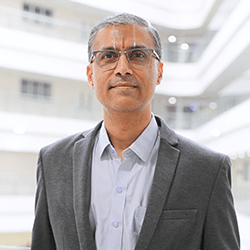
Dr. Rajappa Tadepalli is the CEO of ASPIRE IIT Bombay Research Park Foundation. He holds a B.Tech in Metallurgical Engineering from IIT Madras, and MS and PhD degrees in Materials Science and Engineering from the Massachusetts Institute of Technology (MIT).
With over 18 years of industry experience, he has led innovation and technology programs, built high-performing teams, and driven initiatives delivering sustained business impact. In addition to his research publications, he is the inventor of 24+ patents across materials, IoT platforms, and system solutions.
At ASPIRE, he focuses on enabling the translation of research into real-world applications by strengthening industry–academia collaboration. He is deeply committed to advancing India’s innovation ecosystem and mentoring the development of globally relevant technologies.
National Technology Day celebrates translation of scientific breakthroughs into societal impact. From your experience, what are the most critical factors that determine whether a promising academic technology in India successfully becomes a scalable startup or national solution?
Firstly, academic technologies should be developed on the platform of meaningful problems to solve. In the context of India in 2026, meaningful problems encompass strategic relevance (Atmanirbhar Bharat), societal impact (Sabka Vikas), cost viability and sustainability. Selection of the right projects that cut across these axes is key. Once such projects are defined, it is equally important to have a framework to guide progress by advancing knowledge while holding the focus on deliverables. In this context, academia can benefit from industry partnerships to align development grounded in desirability and viability. Adding government funding to boost such initiatives by derisking early-stage development makes it the perfect trifecta — academia leveraging public-private partnerships to successfully develop scalable technologies.
India is increasingly positioning itself as a global hub for deep‑tech innovation. In your view, which technology areas offer India a genuine global advantage over the next decade? How does your own work contribute to advancing this opportunity?
India is building depth in several areas. Out of these, space and defence technology, healthcare & MedTech and advanced computing could offer a genuine global advantage over the next decade. At ASPIRE IIT Bombay Research Park our mandate is to advance Innovation development towards commercial and societal impact. We are on the path to building a vibrant ecosystem that can accelerate research translation through industry partnerships, pilot test beds and public-private funding mechanisms. We drive curated research engagements through problem statement definition and alignment, clear project structuring, and guidance on project execution meeting stakeholder expectations. We are seeing early results of this model with our member companies in the areas of FinTech, AI-enabled products and services, Robotics, Core materials/chemistry research, among others.
Many of today’s hard problems demand collaboration across chemistry, engineering, data science, medicine, and other fields. How can India better encourage interdisciplinary collaboration, both within institutions and between academia and startups?
Academia is organized by “departments” while Innovation (resulting in commercial and social impact) is inherently interdisciplinary/multidisciplinary. The key is to find the balance between scientific/engineering depth, which the “department” model provides, and the breadth of leveraging this deep knowledge towards problem solving resulting in world-class Innovation. To create this balance, we need to have a constant reconciliation between Technology (depth) and Market (breadth), which is provided by platforms such as ASPIRE IITB Research Park. Government is providing “mission-based” funding which is key to encouraging interdisciplinary problem solving. In addition, shared translational test beds at research parks bring multiple stakeholders together in an “open innovation” model. Finally, we need to minimize the inherent structural barriers to improve time to market.
On this National Technology Day, what advice would you offer to young researchers and entrepreneurs in India who aspire to build globally relevant technologies grounded in strong science?
Firstly, as someone with 20 years of professional experience, out of which 11 were spent in India developing products and solutions from basics to business, it is heartening to see the shift towards entrepreneurship in India. Young researchers have the passion to innovate in India, for India. In fact, people like me need to learn from them! Having said that, my advice would be to
- Build depth in the field of your interest – fundamentals matter.
- Always find a balance between Technology and Market. It is tempting to put Technology first, but one needs to constantly check the desirability from a user perspective, and viability from a cost perspective.
- Develop IP as a business-strategy tool, beyond numbers.
I wish the very best for young entrepreneurs in India, on this occasion of National Technology Day 2026.
Prof. Ambarish Ghosh
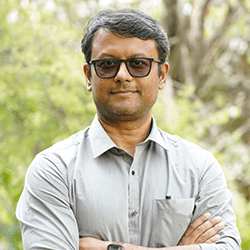
Prof. Ambarish Ghosh studied Physics at the Indian Institute of Technology, Kharagpur, completed his PhD in Physics at Brown University, USA, and was a postdoctoral fellow at Harvard University, USA. Currently, he is a professor at the Indian Institute of Science, Bangalore, and co-founder of the medical device startup, Theranautilus. His research spans quantum fluids, plasmonics, driven colloidal systems, and their applications in biotechnology. He is an elected fellow of the engineering and the three science academies in India. Among several honors, he was awarded Shanti Swaroop Bhatnagar Prize in 2018, the Tata Transformation Prize in 2025, and the Oral Innovations Award from International Association from Dental Research in 2026.
National Technology Day celebrates translation of scientific breakthroughs into societal impact. From your experience, what are the most critical factors that determine whether a promising academic technology in India successfully becomes a scalable startup or national solution?
Promising academic technology in India often loses momentum at three predictable points. First, there is very little pre-entrepreneurship support; young researchers need worry-free time and resources to refine their technology, without paying for it through a stalled academic career. We don't yet protect that window. Second, we lack deep-tech prototyping facilities. In semiconductors, for instance, three working devices can carry a strong academic paper, and a handful of places like IISc can support that. But a convincing technology demonstration needs hundreds of devices, fabricated reproducibly, and India has no equivalent of Interuniversity Microelectronics Centre (IMEC). Third, deployment partners willing to take risk are scarce. Deep-tech products are rarely simple, and our VC ecosystem is still learning to wait long enough. Things are improving, the tech hubs are doing good work, but they need to become more dynamic and meritocratic.
India is increasingly positioning itself as a global hub for deep‑tech innovation. In your view, which technology areas offer India a genuine global advantage over the next decade? How does your own work contribute to advancing this opportunity?
Three areas, in my view: semiconductors, quantum, and health. All three are deeply interdisciplinary, demand strong STEM foundations, and we already have credible academic presence in each. They also map onto genuine strategic-sector requirements within the country, which gives them a domestic anchor that purely export-oriented sectors lack. Importantly, much of the underlying enabling technology overlaps across the three, so investment in one cross-fertilizes the others. We should support these in every way possible. My own work in nanorobotics sits squarely at this intersection, it is built on semiconductor fabrication infrastructure, draws on techniques from quantum sensing, and finds its eventual application in healthcare. If we are serious about deep tech in this country, we don't really have the option of not participating in these three.
Many of today’s hard problems demand collaboration across chemistry, engineering, data science, medicine, and other fields. How can India better encourage interdisciplinary collaboration, both within institutions and between academia and startups?
Problems do not care which discipline you were trained in, and this is truer now than ever. For deep tech especially, the same underlying solution often applies across multiple sectors, so multi-disciplinary fluency is essential. The challenge is that interdisciplinary education usually comes at the cost of depth in a core discipline. My view is that at the undergraduate level we should teach fewer core areas, but more rigorously, and then build interdisciplinary breadth through cross-departmental projects. At the Master's and PhD level, what helps most is faculty from different areas jointly taking on students. Beyond institutions, city-based knowledge clusters that bring industry, academia, and government together around local impact problems are the right model. The Bengaluru Science and Technology Cluster (BeST) where I have been involved from its onset, is one good example. We need many more of these.
On this National Technology Day, what advice would you offer to young researchers and entrepreneurs in India who aspire to build globally relevant technologies grounded in strong science?
Think outside the box and then think hard and deep. Don't look for quick returns. It is far better to work on a problem that could genuinely shake the world, using a method nobody else has thought of. In deep tech, niche is your closest friend; quick returns rarely work, and your depth is your main strength. Strong science is what creates that niche, and it is what protects you from being commoditized later. Think international from day one; build for global relevance, not just local visibility. The path is longer and harder, but it is also the only one that produces technologies the world remembers, and the only one worth taking if your ambition is to build something genuinely original from India.
Dr. Radhika Trikha

Dr. Radhika Trikha is the CEO of IIT Ropar Technology and Innovation Foundation - Agriculture and Water Technology Development Hub (AWaDH), a Section 8 company at IIT Ropar under the National Mission on Interdisciplinary Cyber Physical Systems (NM-ICPS), Department of Science and Technology (DST), Government of India. Dr. Trikha brings a wealth of experience and a robust background in policy research, having significantly contributed to India's 5th National Science, Technology, and Innovation Policy draft. Her expertise in shaping policy frameworks has been instrumental in enhancing the Science, Technology, and Innovation (STI) ecosystem in India. She has held DST-STI-PRC fellowships, including a Senior Policy Fellowship from the Indian Institute of Sciences, Bangalore (CPR@IISc Bangalore) and a Postdoctoral Fellowship from Panjab University, Chandigarh (CPR@PU Chandigarh). She previously held significant roles as Senior Scientist D – Assistant Coordinator and Senior Scientist C at the DST established Centre for Policy Research, Panjab University, Chandigarh, where she played a pivotal role in advancing science and technology policy research. Through these roles, she has advanced public-private partnerships, industry-academia collaborations, science diplomacy, and innovation management.
A gold medalist from Guru Nanak Dev University and Panjab University, Dr. Trikha holds a PhD under the INSPIRE Fellowship with academic training in Microbial Biotechnology. She has completed advanced courses in Intellectual Property Rights (IPRs), Science Diplomacy, and Innovation Management, and holds an MBA in International Business Management.
Dr. Trikha's contributions extend beyond academia and policy. She is actively involved in promoting entrepreneurship and innovation, particularly in the deep-tech sector. She has spearheaded initiatives that bridge the gap between research and industry, fostering a culture of innovation and practical application of cutting-edge technologies. Her work in skilling and capacity building has empowered numerous individuals and startups, driving significant advancements in the domains of agriculture and water technology.
National Technology Day celebrates translation of scientific breakthroughs into societal impact. From your experience, what are the most critical factors that determine whether a promising academic technology in India successfully becomes a scalable startup or national solution?
Translation fails not at the idea stage, it fails at the handoff. In my experience running iHub AWaDH under the Department of Science and Technology (DST)'s National Mission on Interdisciplinary Cyber-Physical Systems, three factors are decisive:
- Technology Readiness ≠ Market Readiness. Most academic innovations exit labs at TRL 3-4. Bridging to TRL 7-9 requires structured product studio environments, not just funding (TRL means Technology Readiness Level; it is a metric used to assess the maturity level of a particular technology). At AWaDH, we operate a Product Studio Model specifically for this: pairing R&D teams with startup cohorts for co-development. At AWaDH, 13 technologies have been commercially transferred, and 50+ products are in active market deployment from our portfolio.
- Patient, milestone-linked capital. Our 170+ portfolio startups have received ₹162.2 million in seed investment with disbursals tied to performance milestones. This discipline, not just the quantum, determines whether startups scale or stall. Our portfolio has gone on to raise over ₹0.96 billion in follow-on funding, with a combined valuation exceeding ₹13 billion. The multiplier is only possible when early capital is structured smartly.
- Ecosystem density around the innovation. A technology rarely scales alone. It needs regulatory navigation, IP protection, talent, procurement linkages, and sectoral networks. AWaDH's 220+ industry, government, and academic collaborations, including the Ministry of Electronics and Information Technology (MeitY), Startup India, Farmer Producer Organisations etc., create the connective tissue that converts lab outputs into national solutions. Bilateral linkages are insufficient; ecosystem architecture is the differentiator.
The honest lesson: India's gap is not in scientific talent; it is in the translational ecosystem. National Mission on Interdisciplinary Cyber-Physical Systems (NM-ICPS) is precisely the policy instrument designed to address the gap of technology translation ecosystem in emerging technologies.
India is increasingly positioning itself as a global hub for deep‑tech innovation. In your view, which technology areas offer India a genuine global advantage over the next decade? How does your own work contribute to advancing this opportunity?
India's advantage lies not just in where it is strong, but in where global problems intersect with Indian scale and context.
Agriculture and Food Systems Technology is the clearest case. India feeds 1.4 billion people, manages 17% of the world's livestock, and faces compounding stress on water and soil. The solutions we build here like our IoT-based precision irrigation platforms (AutoFarm), AI-driven biodiversity mapping tools deployed in 10+ countries across 30+ sites, and our nanobubble-based water treatment systems are not incremental improvements. They are globally exportable architectures for climate-resilient food systems.
Cyber-Physical Systems and IoT is the second. India's engineering talent combined with cost-effective hardware iteration cycles give us a structural advantage in building embedded intelligence for resource-constrained environments. This is the architecture of the future, and India is not a follower here; we can be a standard-setter.
Frugal deeptech for the Global South is the third, often underappreciated, edge. Solutions built for India’s low-cost, multilingual digital agriculture technologies led by Annam AI Foundation, an AI Center of Excellence for Agriculture supported by the Ministry of Education, Government of India, supports scalable technologies to informal sectors. These kinds of innovations are precisely what 5 billion people across Africa, Southeast Asia, and Latin America need. India's deep tech is, uniquely, globally relevant by default.
At AWaDH, we are already demonstrating this: our Moonshot biodiversity sensor is deployed in 30+ countries, Indra Systems (wastewater recycling) has raised ₹370 million from global climate investors including Emerald Technology Ventures, and our SpINe network of 20+ partner institutions is building a distributed national Cyber-Physical Systems (CPS) research base.
Many of today’s hard problems demand collaboration across chemistry, engineering, data science, medicine, and other fields. How can India better encourage interdisciplinary collaboration, both within institutions and between academia and startups?
The challenge is often structural as much as cultural. India’s academic incentive systems, faculty evaluation mechanisms, journal preferences, and departmental silos can sometimes make interdisciplinary collaboration difficult. For example, researchers working at the intersection of Life Sciences and Computer Science & Engineering may receive limited recognition for cross-domain contributions if evaluation systems primarily value publications within a single core discipline, such as Computer Science. Until the incentive architecture changes, interdisciplinarity will remain aspirational.
Specific interventions that work and that I've seen work at AWaDH:
Within institutions: Create thematic hub structures that own funding, infrastructure, and outcomes across departments. AWaDH operates six interdisciplinary thematic verticals: agriculture, water, livestock, energy, food systems, and Cyber-Physical Systems, each led by a Domain Coordinator drawing from multiple departments. This is different from a "Center" on paper; it has ring-fenced budgets, co-PI accountability, and shared student pools. DST's NM-ICPS design mandated this, and it works.
Between academia and startups: The missing link is co-development agreements with IP clarity upfront. Fear of IP conflicts is the single biggest reason researchers don't collaborate with startups.
At the national level: India needs a translational research funding category that is explicitly evaluated on cross-disciplinary output metrics: not journal impact factors, but prototypes deployed, startups co-founded, and patents licensed. DST's NM-ICPS is a model. It needs replication across other ministries and mission-mode expansion.
On this National Technology Day, what advice would you offer to young researchers and entrepreneurs in India who aspire to build globally relevant technologies grounded in strong science?
Build on real problems, not imagined markets. India has the extraordinary privilege of being surrounded by hard, important, unsolved problems in water quality, food safety, healthcare access, and climate resilience. If your technology doesn't have an answer to "who is suffering without this today?", go back to the problem, not to the literature.
Understand the full stack from molecule to market. The researchers who have lasting impact are those who can read a World Intellectual Property Organization (WIPO) patent claim, pitch to a seed fund, and explain their innovation to a farmer or a patient. Cross-functional fluency is not a soft skill; it is the core skill of the 21st century scientist-entrepreneur.
Publish, patent, and protect; in that order. India generates over 80,000 patents a year, but patent-to-commercialization rates remain below 5%. Build IP discipline early. A single well-structured technology license can fund years of R&D.
And finally: this moment is yours. India has invested over ₹36 billion through NM-ICPS across 25 Technology Innovation Hubs. India AI Mission, National Quantum Mission, National Semiconductor Mission, Startup India, Biotechnology Industry Research Assistance Council (BIRAC), National Initiative for Developing and Harnessing Innovations (NIDHI), and the broader DST ANRF Research Development and Innovation Fund (RDIF) architecture are the most enabling policy environments young Indian technologists have ever had.
The nation doesn't need more papers on its problems. It needs more builders of its solutions.
Explore Research Highlights Published in ACS Journals
Unlocking Efficient Electrochemical Urea Oxidation and Understanding Mechanism Insights of Co-Doped NiS
Prachi Upadhyay, Artina Deka, and Sankar Chakma*
DOI: 10.1021/acsengineeringau.5c00034
Machine Learning Assisted Image Analysis for Microalgae Prediction
Karthikeyan Meenatchi Sundaram, Sikhakolli Sravan Kumar, Anuj Deshpande, Sunil Chinnadurai, and Karthik Rajendran*
DOI: 10.1021/acsestengg.4c00598
Carbamate Prodrugs Restrict In Vivo Metabolism and Improve the Pharmacokinetics of Isoniazid
Jishnu Sankar, Manish Kumar Bajpai, Anjali Chauhan, Ravi Maddheshiya, Nidhi Sharma, Aditya Sharma, Yashwant Kumar, and Dinesh Mahajan*
DOI: 10.1021/acscentsci.5c00576
On-Chip Full-UV-Band Photodetectors Enabled by Hot Hole Extraction
Sougata Karmakar, Soham Ash, Sinorul Haque, N. K. Murugasenapathi, M. Sridevi, Indrajeet Mandal, Gurupada Ghorai, A. V. Muhammed Ali, Nitya Nand Gosvami, N. M. Anoop Krishnan, Sayan Kanungo, Manohar Chirumamilla, Tamilarasan Palanisamy, Rajiv K. Singh, Amarnath R. Allu*, and K. D. M. Rao*
DOI: 10.1021/acsnano.4c16106
CO2 Capture from Flue Gas on a Pilot Scale Using Porous Carbon Prepared from Cotton Stalk Crop Residues through an Industrially Viable Activation Process
Vineet Kumar, Mayur Bhalani, Jigar Andharia, Partha Pratim Mondal, Pratyush Maiti, Subhadip Neogi, and Subarna Maiti*
DOI: 10.1021/acs.iecr.3c04117
A Confined Impinging Jet Reactor for High-Throughput Continuous Flow Mononitration of Salicylic Acid
Muzammilanwar S. Khan, Tabrez R. Shaikh, Sphurti P. Kulkarni, Abhishek A. Patil, and Amol A. Kulkarni*
DOI: 10.1021/acs.oprd.4c00467
Graphene-Encapsulated Transition Metal@N/C Catalysts for Catalytic Copyrolysis of Biomass and Waste Plastics: Production of Linear α-Olefins and Aromatics
T. Nandakumar, Subhan Kumar Pal, Ravikrishnan Vinu, Palmurukan M. Ramar, Kamal Kishore Pant*, Sanat Kumar*, and Ekambaram Balaraman*
DOI: 10.1021/acssuschemeng.4c00279
Advancing Peripheral Nerve Regeneration: 3D Bioprinting of GelMA-Based Cell-Laden Electroactive Bioinks for Nerve Conduits
Soumitra Das, Jeyapriya Thimukonda Jegadeesan, and Bikramjit Basu*
DOI: 10.1021/acsbiomaterials.3c01226